

Making money online does not always mean working for clients, building a large social media following, or selling physical products. One of the simplest online business models for beginners is creating and selling digital products.
Digital products are files or online resources that customers can buy and download or access through the internet. Examples include ebooks, printable planners, templates, spreadsheets, online courses, checklists, and digital guides.
If you are exploring different online income options, you can also check out these legit ways to make money online for beginners.
The best part is that you can create a digital product once and potentially sell it multiple times without dealing with inventory, packaging, or shipping. This makes digital products an interesting option for beginners who want to learn how to make money online.
However, creating a product does not automatically mean people will buy it. You need to understand what people want, create something genuinely useful, price it sensibly, and learn how to reach potential customers.
In this guide, you will learn how to make money with digital products for beginners, what types of products you can create, how to choose an idea, where to sell your products, how to market them, and common mistakes to avoid.
What Are Digital Products?
Digital products are products that are created, delivered, and used electronically rather than being physically shipped to customers.
For example, instead of printing a budgeting planner and mailing it to someone, you can create a PDF version that the customer downloads after purchasing it.
Some common digital products include:
- Ebooks
- PDF guides
- Budget planners
- Printable worksheets
- Notion templates
- Spreadsheet templates
- Resume templates
- Social media templates
- Checklists
- Digital artwork
- Online courses
- Educational resources
- Business templates
- Meal planners
- Study planners
Digital products can solve many different problems. A student might buy a study planner, a freelancer might buy an invoice template, and someone trying to manage their money might buy a budgeting spreadsheet.
Digital products can include downloadable files such as ebooks, videos, audio, and digital artwork, which customers can access electronically. Shopify’s guide to digital products
The important thing is not simply creating a digital file. Your product should make something easier, faster, clearer, or more organized for the customer.
Why Are Digital Products Good for Beginners?
Digital products have several characteristics that make them attractive to people starting an online business.
Low Startup Costs
You usually do not need to purchase inventory before creating your product.
Many digital products can be created with tools that are free or inexpensive. For example, you can create a simple PDF guide using a document editor and design it using a free graphic design tool.
This means you can test an idea without investing heavily in stock.
No Physical Inventory
With physical products, you may need storage space, packaging materials, and inventory management.
Digital products do not require a warehouse or cupboard full of products.
Your product can simply exist as a downloadable file or online resource.
No Shipping
A customer can receive a digital product almost immediately after purchasing it.
There is no need to calculate shipping costs, prepare a package, or visit a delivery service.
Products Can Be Sold More Than Once
One of the biggest advantages of digital products is that the same product can potentially be sold to many customers.
For example, imagine you create a beginner budgeting spreadsheet. You spend time creating and testing it once. After that, the same file can potentially be purchased by many different customers.
This does not mean sales are guaranteed. You still need to attract customers and maintain the quality of your product.
You Can Start Small
You do not need to create a huge online course or write a 200 page ebook on your first attempt.
A simple checklist, template, or short guide can be a better starting point.
The goal is to learn how the process works before making your business more complicated.
10 Digital Products You Can Sell as a Beginner
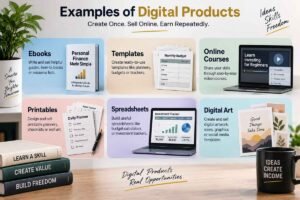
There are many types of digital products you can create. Here are some beginner friendly ideas.
1. Ebooks
An ebook can teach readers how to solve a specific problem.
Instead of writing a general book about “making money,” you could create something more specific, such as a beginner’s guide to creating a personal budget.
The more specific the problem, the easier it can be to explain the value of your product.
2. Printable Planners
Printable planners can help customers organize their days, finances, studies, workouts, or projects.
Examples include:
- Monthly budget planners
- Weekly planners
- Savings trackers
- Study planners
- Habit trackers
- Goal setting worksheets
3. Spreadsheet Templates
Spreadsheets can be useful for people who want to track information without building their own system.
You could create templates for:
- Monthly budgeting
- Expense tracking
- Savings goals
- Freelance income
- Business expenses
- Project planning
A good spreadsheet should be simple enough for a beginner to understand.
4. Checklists
A checklist can turn a complicated process into a series of simple steps.
For example, you could create a “First Freelance Client Checklist” or a “Beginner Blog Launch Checklist.”
People often pay for convenience, especially when a checklist saves them time and prevents them from forgetting important steps.
5. Templates
Templates can save customers from starting from a blank page.
Examples include:
- Resume templates
- Business proposal templates
- Invoice templates
- Social media templates
- Email templates
- Presentation templates
6. Online Courses
If you have useful knowledge about a subject, you can organize it into a beginner friendly course.
However, courses usually require more work than simple digital products because you may need to create lessons, videos, worksheets, and other resources.
For your first product, a smaller product may be easier to manage.
7. Digital Guides
A digital guide focuses on helping someone complete a particular task.
For example:
“A Beginner’s Guide to Starting a Freelance Writing Business”
The guide could explain the process step by step and provide worksheets or checklists.
8. Notion Templates
Notion templates can help users organize projects, tasks, notes, finances, or personal goals.
If you understand how to build useful Notion systems, you can package them as digital products.
9. Educational Resources
Educational resources can include worksheets, flashcards, study materials, practice exercises, and learning guides.
The key is to make sure your materials are genuinely useful and original.
10. Digital Bundles
You can combine several related products into one package.
For example, a budgeting bundle might contain:
- Monthly budget planner
- Expense tracker
- Savings tracker
- Debt payoff worksheet
- Financial goals worksheet
A bundle can increase the perceived value of your offer because customers receive several related resources in one purchase.
How to Find a Digital Product Idea

One of the biggest beginner mistakes is creating a product before understanding whether anyone needs it.
Instead, start with a problem.
Ask yourself:
What problem can I help someone solve?
For example:
A student struggles to organize study sessions.
Possible product: Student Study Planner
A freelancer struggles to track income and expenses.
Possible product: Freelancer Finance Spreadsheet
A beginner wants to organize monthly spending.
Possible product: Simple Monthly Budget Planner
The product should be connected to a real problem.
Look at Questions People Ask
Online communities, search engines, forums, and social media can help you discover questions people repeatedly ask.
If people regularly ask how to organize their budget, create a product that makes budgeting easier.
If people frequently ask how to create a resume, a professionally designed resume template may be useful.
The goal is to identify repeated problems rather than simply choosing an idea because you personally like it.
How to Create Your First Digital Product
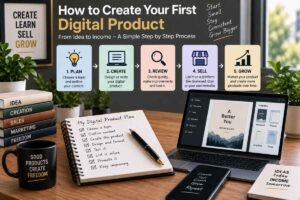
Once you have an idea, keep the first version simple.
Step 1: Define Your Customer
Do not try to create a product for everyone.
Choose a specific audience.
For example:
Beginners who want to start budgeting
is more specific than:
People who want to manage money.
A specific audience makes it easier to decide what information, design, and features your product should include.
If you want to build another online income stream while creating digital products, you can also learn how to start freelancing with no experience.
Step 2: Define the Problem
Write down the exact problem your product solves.
For example:
“My customer wants to track monthly expenses but does not know how to organize a budget.”
Now you have a clear purpose for the product.
Step 3: Create a Simple Solution
Do not add unnecessary features just to make your product look bigger.
If a customer needs a simple budget tracker, create a simple budget tracker.
If they need a checklist, create a useful checklist.
Focus on usefulness rather than size.
Step 4: Make It Easy to Use
A digital product should not require a long explanation before someone can use it.
Use clear instructions, readable fonts, logical sections, and simple navigation.
Remember that beginners may be using your product without any technical knowledge.
Step 5: Test the Product
Before selling it, use the product yourself.
Check every page, link, formula, spelling mistake, and instruction.
If possible, ask someone unfamiliar with the product to test it.
If they become confused, improve the product before launching it.
Where Can You Sell Digital Products?
There are several ways to sell digital products online.
You can use a dedicated digital product marketplace, an ecommerce platform, or your own website.
Your choice depends on your technical skills, budget, audience, and the type of product you want to sell.
Some sellers also use social media to attract potential customers and then send them to a product page.
If you already have a website, you can build your digital product business around your own website and use your content to attract relevant visitors.
For example, a personal finance website could publish helpful budgeting articles and then offer a budgeting template as a related product.
This creates a natural connection between free content and a paid digital product.
Platforms such as Shopify allow sellers to offer digital products and deliver files or links to customers after purchase. Shopify Digital Products guide
How to Price a Digital Product
Pricing can feel difficult when you are selling your first product.
There is no universal price that works for every digital product.
Instead, consider:
- How useful is the product?
- How much time does it save?
- How detailed is it?
- Who is the target customer?
- What alternatives already exist?
- How much value does the product provide?
A simple one page checklist and a comprehensive business template do not necessarily have the same value.
You can also test your pricing over time and adjust it based on customer feedback and sales data.
Avoid choosing a price simply because another seller uses it.
Your product, audience, quality, and positioning may be completely different.
How to Market Digital Products

Creating a product is only half the process.
People need to discover it.
Create Helpful Free Content
One of the most useful ways to market digital products is to create free content around the same problem your product solves.
For example, if you sell a budgeting spreadsheet, you could publish content about:
- How to create a monthly budget
- Common budgeting mistakes
- How to track expenses
- How to save money on a low income
At the end of relevant content, you can naturally introduce your product as an additional resource.
Use Social Media
Social media can help you reach people interested in your topic.
You can create short videos, educational posts, carousels, or tutorials related to your product.
For example, if you sell a savings tracker, you could create a short video explaining why tracking savings matters.
The content should provide genuine value rather than simply telling people to buy your product.
Build an Email List
An email list can help you communicate with people who are interested in your topic.
You could offer a useful free resource and invite visitors to join your email list.
Later, you can send helpful content and introduce relevant paid products.
This can be more sustainable than relying entirely on social media algorithms.
How Much Money Can You Make With Digital Products?
There is no fixed amount that a beginner can expect to earn.
Your results can depend on several factors, including:
- Product quality
- Demand
- Pricing
- Audience size
- Marketing
- Competition
- Customer trust
- Product type
- Sales platform
Some people may make very little from their first product, while others may build larger businesses over time.
It is better to think about digital products as a business model that requires testing and improvement rather than a guaranteed way to make money quickly.
If you promote a business opportunity or make specific earnings claims, the U.S. Federal Trade Commission says those claims need to be truthful and supported by evidence. FTC guidance on earnings claims
Your first goal should be learning how to identify a problem, create a useful solution, attract the right audience, and make your first sales.
As your online income grows, learning how to manage your money can help you make better decisions with what you earn.
Common Mistakes Beginners Should Avoid
Creating Something Nobody Needs
A beautiful product is not useful if there is no demand for it.
Start with the customer’s problem.
Making the Product Too Complicated
Beginners sometimes add too many pages, features, or sections.
More does not always mean better.
Make your product easy to understand and use.
Copying Other People’s Products
Do not copy another creator’s content, templates, designs, or intellectual property.
Instead, study the market to understand what customers need and create your own original solution.
Expecting Instant Sales
Uploading a product does not guarantee customers.
You may need to improve the product, create more content, build trust, and experiment with different marketing approaches.
Ignoring Customer Feedback
Your first version does not have to be perfect.
Pay attention to genuine customer questions and feedback. If multiple customers struggle with the same part of your product, consider improving it.
A Simple Beginner Plan
If you want to start making money with digital products, you can follow this simple process:
Choose a problem → Research the audience → Create a simple product → Test it → Set a reasonable price → Publish it → Promote it → Collect feedback → Improve it → Create another related product
Do not feel pressured to build a huge digital product business immediately.
Start with one useful product.
Learn from the experience.
Then improve your process.
Over time, you can create several related products and potentially combine them into bundles.
Final Thoughts
Learning how to make money with digital products for beginners can be a practical way to explore online business without dealing with physical inventory or shipping.
The most important part is not finding a magical product that automatically generates money. It is finding a real problem and creating a useful solution for a specific audience.
Start small. Choose one problem, create one helpful product, test it carefully, and learn how to market it.
Your first product may not become a huge success, and that is okay. The experience can teach you valuable skills in product creation, marketing, customer research, pricing, and online business.
As you gain experience, you can create better products, understand your audience more clearly, and build a digital product business around the problems you know how to solve.
Frequently Asked Questions
Can beginners really make money selling digital products?
Yes, beginners can sell digital products online, but income is not guaranteed. Success depends on factors such as demand, product quality, pricing, marketing, and customer trust.
What is the easiest digital product to create?
Simple products such as checklists, printable planners, basic templates, and short guides can be easier for beginners to create than large online courses.
Do I need a website to sell digital products?
No. You can use different online platforms to sell digital products. However, having your own website can give you more control over your content, branding, and customer experience.
Can I create digital products with free tools?
Yes. Many beginner friendly digital products can be created using free or low cost tools. The tools are less important than the usefulness and quality of the final product.
How do I choose a profitable digital product idea?
Start by identifying a specific problem that people are actively trying to solve. Research your target audience, study existing products, and look for opportunities to create a clearer, simpler, or more useful solution.
Should I create multiple digital products at once?
It is usually easier to start with one product. Once you understand the creation, selling, and marketing process, you can expand into related products.
Is selling digital products passive income?
Digital products can have lower ongoing fulfillment work than physical products, but they are not automatically passive income. You still need to create products, market them, answer customer questions, update products when necessary, and manage your business.