
Budgeting is usually easier when you receive the same amount of money every month. You know when your paycheck is coming, how much you will receive, and how much you can afford to spend.
Learning how to create a monthly budget with irregular income can feel difficult when you never know exactly how much money you will earn each month.
But things can get difficult when your income changes from month to month.
Maybe you work as a freelancer, run a small business, earn commissions, work different shifts, or have a side hustle. You might earn $2,000 one month and $3,000 the next. Some months may be even lower.
That does not mean you cannot have a budget.
You just need to approach budgeting differently.
Instead of building your entire budget around a fixed monthly income, you can create a system that works during both good and bad months. The goal is to make sure your essential expenses are covered while using higher income months to build savings and prepare for the future.
Here is how to create a monthly budget with irregular income, even if you are just getting started.
Why Is Budgeting With Irregular Income Difficult?
The biggest problem is uncertainty.
When you have a regular paycheck, you might know that you will receive $3,000 every month. With irregular income, you may not know whether next month’s income will be $2,000, $2,500, or $3,500.
Your expenses, however, usually do not change in the same way.
Your rent still needs to be paid. You still need groceries, transportation, utilities, and other essentials.
This is why learning how to create a monthly budget with irregular income is so important. Your budget needs to handle changes without putting your essential expenses at risk.
The goal is not to predict your income perfectly. The goal is to make sure your spending does not depend on your best month.
1. Look at Your Income From the Past 6 to 12 Months

Before creating your budget, find out how much you have actually been earning.
Look at your bank statements, invoices, payment records, or whatever you use to track your income. Write down what you earned each month for at least the past six months.
For example:
| Month | Income |
|---|---|
| January | $2,300 |
| February | $2,700 |
| March | $2,100 |
| April | $2,900 |
| May | $2,400 |
| June | $2,600 |
This gives you a much clearer picture of your income.
You can also calculate your average monthly income. In this example, the average is about $2,500.
However, do not automatically use your average income as your monthly spending limit.
Your average can be useful for planning, but your lower income months are more important when deciding how much you can safely commit to regular expenses.
2. Choose a Conservative Income Number
Now look at your lower income months and choose a realistic number that you can use as your budgeting baseline.
Suppose your income usually falls between $2,000 and $3,000.
Instead of building your lifestyle around $3,000, you could create your basic budget around $2,000 or another amount that you can reasonably expect to earn even during a slower month.
This gives you some breathing room.
For example, if your basic expenses are $1,500 and you earn $2,000, you still have $500 available for savings, debt payments, or other priorities.
If you earn $2,800 the following month, you do not need to increase your spending to $2,800.
The additional income can help you prepare for the months when your earnings are lower.
3. List All of Your Essential Expenses
The next step is to figure out how much you actually need each month.
Write down your essential expenses, including:
- Rent or mortgage
- Groceries
- Electricity and other utilities
- Transportation
- Phone and internet
- Insurance
- Minimum debt payments
- Essential medical costs
- Childcare, if applicable
Add these expenses together.
For example:
| Expense | Monthly Cost |
|---|---|
| Rent | $700 |
| Groceries | $300 |
| Utilities | $150 |
| Transportation | $150 |
| Phone | $50 |
| Debt payments | $100 |
| Insurance | $100 |
| Total | $1,550 |
Now you know that you need around $1,550 to cover your basic monthly expenses.
This number is extremely useful when your income changes because it tells you the minimum amount your budget needs to protect.
4. Separate Needs From Wants

After listing your essential expenses, look at everything else you spend money on.
Eating at restaurants, entertainment, shopping, subscriptions, hobbies, and other optional expenses are not necessarily bad. The problem comes when you treat them as fixed expenses even when your income is unpredictable.
Try dividing your spending into two groups.
Needs are expenses you need to keep paying, such as housing, food, utilities, transportation, and minimum debt payments.
Wants are expenses that you can reduce or pause when money is tight.
If you are new to budgeting, you can also learn how the 50/30/20 budget rule divides your income between needs, wants, and savings.
This gives you flexibility.
During a strong income month, you may have more room for entertainment or personal spending. During a slow month, you can temporarily reduce those expenses without putting your essential bills at risk.
5. Create a Bare Bones Budget
A bare bones budget is the amount you need to cover your most important expenses during a difficult month.
It might look like this:
- Housing: $700
- Groceries: $300
- Utilities: $150
- Transportation: $150
- Phone: $50
- Minimum debt payments: $100
Total: $1,450
You might normally spend $1,900 or $2,000, but your bare bones budget shows what you really need when money is tight.
This can make irregular income much less stressful.
If you have a slow month, you already know which expenses to prioritize and which ones you can reduce.
6. Only Budget Money You Actually Have
One of the easiest mistakes to make with irregular income is spending money before you receive it.
For example, imagine you are expecting a client to pay you $1,000 next week.
You may be confident that the payment is coming, but until it arrives, you should not treat it as money available for today’s spending.
If the payment gets delayed, your budget could suddenly have a large hole in it.
Instead, work with the money you actually have available.
This simple habit can prevent a lot of financial stress, especially when you work with clients or rely on payments that do not arrive on a fixed schedule.
7. Give Your Income a Purpose
Whenever you receive money, decide where it needs to go before you start spending it.
For example, suppose you receive $1,500 from a freelance project.
You could use part of it for upcoming essential expenses, put some into savings, make a debt payment, and set aside money for expenses you know are coming later.
The exact amounts will depend on your situation.
The important part is to avoid looking at the entire $1,500 as spending money.
Giving your money a purpose makes it much easier to stay in control when your income changes.
8. Use High Income Months to Prepare for Low Income Months

This is one of the most important habits for anyone with irregular income.
Let’s say your baseline budget is $2,000, but you earn $2,800 in one month.
You now have an extra $800 compared with your normal baseline.
Instead of immediately increasing your spending, consider using some of that money to build a financial cushion.
You could put it toward:
- Emergency savings
- Upcoming bills
- Debt repayment
- Sinking funds
- Long-term savings
- Investing
The exact priority depends on your financial situation.
Over time, these extra contributions can make your income feel more stable because you have money available when your earnings drop.
If your income is already tight, you can also explore these money saving strategies for beginners on a low income to find ways to reduce your everyday spending.
9. Save for Expenses That Do Not Happen Every Month
Some expenses are easy to forget because they do not appear every month.
You might have an annual insurance payment, car maintenance, school expenses, gifts, property repairs, or yearly subscriptions.
Instead of waiting for these expenses to arrive, start saving for them ahead of time.
For example, if you expect to spend $1,200 on annual expenses, divide that amount by 12.
$1,200 ÷ 12 = $100
You could put $100 aside each month.
This is often called a sinking fund.
It helps prevent a large yearly expense from turning into a financial emergency.
10. Build an Emergency Fund
An emergency fund is especially important when your income is unpredictable.
If your income suddenly drops or you have an unexpected expense, your savings can help you cover the cost without immediately relying on a credit card or loan.
If you do not have any savings right now, start with a small goal.
Your first target could be $500 or $1,000. Once you reach that amount, you can continue building your emergency fund based on your expenses and income situation.
The Consumer Financial Protection Bureau explains that an emergency fund can help cover unexpected expenses such as medical bills, repairs, or a loss of income.
If you want to learn more, check out our guide on How to Build an Emergency Fund From Scratch.
11. Have a Plan for Extra Money
When you have an unusually good month, decide what you will do with the extra money before you receive it.
For example, you could create a simple rule:
Extra income goes toward savings, debt, upcoming expenses, investing, and then personal spending.
You do not have to follow that exact order.
The point is to make the decision ahead of time.
Otherwise, extra money can disappear surprisingly quickly through unnecessary purchases and lifestyle upgrades.
A higher income month should improve your financial position, not simply increase your monthly expenses.
If you have high-interest debt, putting some of your extra income toward debt can help you become financially stable faster. Our guide on how to pay off debt faster covers several strategies you can use.
12. Review Your Budget Every Month
Your budget should change when your circumstances change.
At the end of each month, take a few minutes to review what happened.
Ask yourself:
- How much did I earn?
- How much did I spend?
- Did I cover all my essential expenses?
- Which expenses were higher than expected?
- How much did I save?
- Did I have any unexpected costs?
- What should I change next month?
If your income pattern changes, update your budget as well.
You do not need to create a completely new system every month. Small adjustments are usually enough.
Budgeting is only one part of managing your finances. You can also learn more about how to manage your money like a pro by building simple habits that keep your finances organized.
How to Create a Monthly Budget With Irregular Income: Example
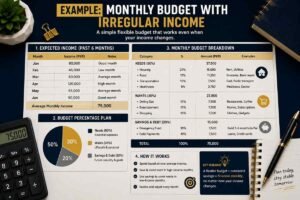
Let’s say you are a freelancer and your income usually ranges from $2,000 to $3,000.
You decide to use $2,000 as your conservative monthly baseline.
Your budget could look like this:
| Category | Amount |
|---|---|
| Housing and utilities | $800 |
| Groceries | $300 |
| Transportation | $150 |
| Phone and internet | $75 |
| Minimum debt payments | $100 |
| Sinking funds | $100 |
| Emergency savings | $150 |
| Personal spending | $150 |
| Total | $1,825 |
This leaves you with $175 of flexibility even during your baseline month.
Now imagine you earn $2,600 instead.
Rather than increasing your lifestyle by $600, you could use the extra money to strengthen your emergency fund, pay down debt, prepare for future expenses, or invest for long term goals.
That is the advantage of budgeting around a conservative income number.
Common Mistakes to Avoid
Spending based on your best month
A good month does not guarantee that the next month will be good too. Avoid creating permanent expenses based on temporary income.
Treating extra income as free money
Extra income can be useful for building savings and preparing for future expenses. Spending all of it immediately can leave you vulnerable later.
Forgetting irregular expenses
Car repairs, annual bills, gifts, and other occasional expenses are still part of your overall financial picture.
Ignoring taxes
If you are self employed or earn money without taxes being automatically deducted, make sure you understand your tax responsibilities and set aside money when necessary.
Keeping fixed expenses too high
The more money you commit to fixed monthly payments, the harder it becomes to manage a low income month.
If you are self employed or earn money without taxes being automatically deducted, make sure you understand your tax responsibilities and set aside money when necessary. For example, the IRS explains that people who are self employed may need to make estimated tax payments because taxes are generally paid as income is earned
Frequently Asked Questions
How do you budget with irregular income?
Use a conservative income estimate based on your lower income months. Cover essential expenses first, then use extra income for savings, debt, and other goals.
Should you budget based on your average income?
Your average income can help with planning, but it is safer to build your basic budget around a lower, more reliable income level.
How much should you save with irregular income?
Start with an amount you can comfortably save each month. During higher income months, try to save more and build a financial cushion.
What should you do during a low income month?
Focus on essential expenses, reduce non essential spending, and use your savings buffer if necessary. Avoid taking on new debt whenever possible.
Final Thoughts
Learning how to create a monthly budget with irregular income is not about knowing exactly how much money you will earn every month.
Learning how to create a monthly budget with irregular income is not about knowing exactly how much money you will earn every month.
It is about creating a system that can handle uncertainty.
Start by reviewing your past income and finding a realistic baseline. Then calculate your essential expenses, create a bare bones budget, and make sure you are not spending money before you actually receive it.
When you have a strong income month, use some of that extra money to prepare for the future instead of immediately increasing your lifestyle.
It may take some time to get used to budgeting this way, but once you have a system that works, irregular income becomes much easier to manage.
Your income may change from month to month. Your financial plan does not have to fall apart every time it does.