
 Investing can seem confusing when you’re just getting started. You may think you need thousands of dollars, expert knowledge, or years of experience before you can invest successfully. The good news is that none of those things are true. we will learn about How to Start Investing as a Beginner step by step with a proper guide.
Today, investing is more accessible than ever. With the right knowledge and a clear plan, beginners can start building wealth with small amounts of money and grow their investments over time. The key is not to become rich overnight but to make smart, consistent decisions that help your money grow.
In this beginner friendly guide, you’ll learn exactly how to start investing step by step, understand the different investment options, avoid common mistakes, and build a strong financial foundation for your future.
What Is Investing?
Investing means putting your money into assets that have the potential to increase in value over time. Instead of letting your money sit idle, investing allows it to work for you by generating returns through growth, interest, or dividends.
Unlike saving, which focuses on protecting your money for short term goals and emergencies, investing is designed for long term wealth building. Although investments can rise and fall in value, they have historically provided higher returns than keeping money in a regular savings account over long periods.
For example, when you buy shares of a company, you’re purchasing a small ownership stake in that business. If the company grows and becomes more valuable, your investment may also increase in value. Some companies also pay dividends, providing investors with an additional source of income.
If you’re completely new to investing, the educational resources available on Invester.gov provide a helpful introduction to investing basics, investment risks, and investor protection.
The most important lesson for beginners is that investing is a long term journey. Successful investors don’t rely on luck or quick profits they focus on patience, consistency, and disciplined decision making.
Why Should You Start Investing Early?

One of the biggest advantages a beginner has isn’t a large income it’s time.
The earlier you start investing, the more opportunity your money has to grow through compound returns. Compounding happens when your investment earnings begin generating their own earnings, creating a snowball effect over many years.
Imagine two people who invest the same amount each month. One starts in their twenties, while the other waits until their forties. Even if the second person invests more money later, the first investor often ends up with a larger portfolio because their investments had more time to grow.
This is why financial experts often say that time in the market is more important than trying to perfectly time the market.
Starting early also helps you develop healthy financial habits. By investing regularly, you learn discipline, avoid emotional decision-making, and gradually become more confident as an investor.
The goal isn’t to find the perfect investment. The goal is to begin with a sensible plan and stay consistent over the years
Step 1: Build a Strong Financial Foundation
Before investing your first dollar, make sure your financial foundation is solid.
Many beginners rush into investing without preparing their finances first. This can create unnecessary stress if unexpected expenses arise.
Before you invest, focus on these essentials:
- Create a monthly budget using a proven method like the 50/30/20 budget rule so you understand your income and expenses.
- Build an emergency fund that can cover three to six months of essential living expenses.
- Pay off high interest debt, especially credit card balances.
- Set clear financial goals, such as buying a home, retiring comfortably, or building long term wealth.
Once these basics are in place, you’ll be in a much stronger position to invest confidently without needing to sell your investments during financial emergencies.
Remember, investing is most effective when it supports a healthy financial plan not when it replaces one.
Step 2: Set Clear Investment Goals

Before choosing where to invest your money, you need to know why you’re investing. Your financial goals will influence the types of investments you choose, how much risk you’re comfortable taking, and how long you’ll keep your money invested.
Ask yourself questions like:
- Are you investing for retirement?
- Do you want to buy a house in the future?
- Are you building wealth for financial independence?
- Do you want to save for your children’s education?
Having a clear goal helps you stay focused, especially when the market experiences temporary ups and downs. Investors who know their purpose are less likely to panic and make emotional decisions.
A simple way to stay motivated is to write down your investment goal and set a target date. Whether your goal is 10, 20, or 30 years away, having a plan makes it easier to remain consistent.
Step 3: Understand the Main Types of Investments
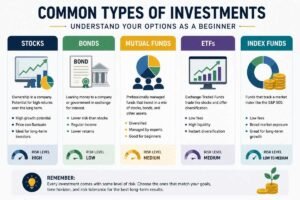
As a beginner, you don’t need to invest in everything. Understanding the most common investment options will help you make informed decisions.
Stocks
Stocks represent ownership in a company. When the company grows, the value of your investment may increase. Some companies also pay dividends, providing an additional source of income.
Stocks offer strong long term growth potential, but their prices can fluctuate in the short term. That’s why they’re generally best suited for long term investors.
Bonds
Bonds are loans you make to governments or companies in exchange for regular interest payments. They usually carry lower risk than stocks but often provide lower returns.
Many investors include bonds in their portfolio to reduce overall risk.
Mutual Funds
Mutual funds combine money from many investors and are managed by professional fund managers. Instead of buying individual stocks or bonds yourself, you own a small share of a diversified portfolio.
They are a popular choice for beginners who prefer professional management.
Exchange-Traded Funds (ETFs)
ETFs are similar to mutual funds but trade on stock exchanges like individual stocks. They usually have lower fees and provide instant diversification by investing in many companies at once.
For many beginners, ETFs are one of the simplest and most cost effective ways to start investing.
Index Funds
Index funds are designed to track the performance of a market index rather than trying to outperform it. Because they require less active management, they typically have lower fees and have become a favorite option for long-term investors.
Step 4: Know Your Risk Tolerance
Every investment carries some level of risk. The key isn’t avoiding risk completely it’s choosing investments that match your financial situation and comfort level.
Your risk tolerance depends on factors such as:
- Your age
- Your financial goals
- Your investment timeline
- Your income stability
- How comfortable you are with market fluctuations
For example, if you’re investing for retirement that’s decades away, you may be able to tolerate more short term market volatility because you have time to recover from temporary declines.
On the other hand, if you need your money within a few years, choosing lower risk investments may be more appropriate.
The most successful investors understand that short term market movements are normal. Instead of reacting emotionally, they stick to their long term plan and continue investing consistently.
Remember, investing isn’t about finding a “perfect” investment. It’s about building a diversified portfolio that aligns with your goals and risk tolerance.
Step 5: Open Your First Investment Account

Once you’ve set your goals and understand the basics of investing, the next step is opening an investment account.
Choose a trusted brokerage or investment platform that offers low fees, a user friendly interface, and access to the investments you want. Before creating an account, compare important features such as:
- Account fees
- Investment options
- Customer support
- Educational resources
- Mobile app experience
- Security features
Many platforms allow beginners to start with small amounts of money, making investing more accessible than ever.
Take your time when choosing a platform. A reliable investment account will support your financial journey for many years.
Step 6: Make Your First Investment
Making your first investment can feel intimidating, but it doesn’t have to be.
Instead of trying to predict which stock will become the next big winner, focus on building a diversified portfolio. Many beginners choose broad market ETFs or index funds because they provide exposure to many companies with a single investment.
You also don’t need to invest a large amount. Starting with a small, affordable contribution every month is often better than waiting until you have more money.
Consistency is one of the most powerful investing habits. Regular contributions, even small ones, can grow significantly over time.
Remember, investing is a marathon not a sprint.
Step 7: Diversify Your Portfolio

One of the most important principles of investing is diversification.
Diversification means spreading your money across different types of investments instead of relying on a single company or asset.
For example, rather than investing all your money in one stock, you could own a diversified portfolio containing:
- Stocks
- Bonds
- ETFs
- Index funds
Diversification helps reduce risk because if one investment performs poorly, others may help balance your portfolio.
To learn more about diversification and how it helps reduce investment risk, you can explore the beginner friendly resources available from the U.S. Securities and Exchange Commission (SEC).
While diversification cannot eliminate investment risk entirely, it is one of the most effective ways to manage it over the long term.
Common Investing Mistakes Beginners Should Avoid
Every investor makes mistakes, but learning about them early can save both time and money.
Here are some of the most common beginner mistakes:
- Investing without clear financial goals.
- Trying to get rich quickly.
- Putting all your money into a single investment.
- Making emotional decisions during market ups and downs.
- Ignoring diversification.
- Investing money you’ll need in the near future.
- Waiting too long because you’re afraid of making mistakes.
Remember, successful investing isn’t about being perfect. It’s about making informed decisions and staying consistent over the long term.
If you are struggling to save your first investment, check out our guide on a how to save money on a low income as a beginner for practical strategies to start building your investment fund.
Final Thoughts
Starting your investment journey may seem overwhelming at first, but every experienced investor was once a beginner.
You don’t need a large income or expert level knowledge to begin. What matters most is developing good financial habits, setting clear goals, investing consistently, and staying patient.
The sooner you start, the more time your investments have to grow. Even small, regular contributions can make a meaningful difference over the years.
Rather than searching for the perfect investment, focus on creating a simple long term plan that matches your goals and risk tolerance.
Investing is one of the most powerful tools for building financial security and achieving long term wealth. The best time to start was yesterday the second best time is today.
Frequently Asked Questions
1. How much money do I need to start investing?
Many investment platforms allow beginners to start with a relatively small amount. The key is to invest consistently rather than waiting until you have a large sum.
2. Is investing risky for beginners?
All investments involve some level of risk. However, investing for the long term, diversifying your portfolio, and making informed decisions can help reduce unnecessary risk.
3. Should I pay off debt before investing?
High-interest debt should generally be prioritized before investing because the interest costs may outweigh potential investment returns.
4. What’s the best investment for beginners?
There is no single “best” investment for everyone. Many beginners choose diversified investments such as ETFs or index funds because they provide broad market exposure and lower risk than investing in individual stocks.
5. Can I start investing with a low income?
Yes. Consistency matters more than the amount you invest. Even small, regular contributions can grow over time through long-term investing.