

Investing can feel confusing when you are just starting out. There are stocks, bonds, mutual funds, ETFs, index funds, and many other investment options. With so many choices, it is easy to wonder where you should even begin.
One option that many beginners consider is an ETF, or exchange traded fund.
ETFs can give you access to many investments through a single fund. Instead of researching and buying dozens of individual stocks, you can buy one ETF that holds a collection of investments. This can make investing simpler and can help spread your money across different companies or assets.
But that does not mean every ETF is automatically a good investment. You still need to understand how ETFs work, what you are buying, what fees you are paying, and how much risk you are taking.
In this guide, we will explain how to invest in ETFs for beginners, step by step. By the end, you will understand what an ETF is, how to choose one, how to buy it, and some common mistakes you should avoid.
What Is an ETF?
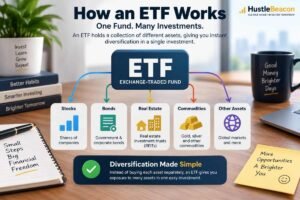
An ETF is a type of investment fund that holds a collection of assets such as stocks, bonds, commodities, or other investments.
ETF stands for exchange traded fund because its shares can be bought and sold on a stock exchange during the trading day, similar to an individual stock.
For example, imagine you want to invest in 500 large companies. Buying shares of every company individually would require a lot of money, research, and effort.
Instead, you could invest in an ETF that tracks a major stock market index. One purchase can give you exposure to hundreds of companies.
This is one of the main reasons ETFs are popular with beginners.
A Simple Example
Suppose you have $100 to invest.
Instead of putting the entire $100 into one company, you buy an ETF that holds hundreds of different companies.
Your $100 is now spread across those investments.
If one company performs poorly, it does not necessarily destroy your entire investment because your money is spread across many holdings.
This is called diversification.
Diversification does not eliminate investment risk, but it can reduce the impact of one individual investment performing badly.
How Do ETFs Work?
The basic idea behind an ETF is fairly simple.
A fund provider creates an ETF and fills it with a group of investments. The ETF then issues shares that investors can buy through a brokerage account.
The investments inside the ETF depend on its objective.
Some ETFs track stock market indexes. Others focus on specific industries, countries, bonds, commodities, or investment strategies.
For example, one ETF might track a broad U.S. stock market index, while another might focus only on technology companies.
When you buy a share of an ETF, you are buying a small ownership interest in the entire portfolio held by that fund.
The value of your ETF shares generally changes as the value of the investments inside the ETF changes.
Why Should Beginners Consider ETFs?
If you are completely new to investing, it can help to first understand the basics of investing before choosing specific investments. Our guide on how to start investing as a beginner can help you understand the first steps.
1. ETFs Can Provide Diversification

One of the biggest advantages is diversification.
Instead of investing all your money in one company, you can choose an ETF that holds many different investments.
This can help reduce the risk associated with relying on a single company.
For a beginner, diversification can be especially useful because picking individual winning stocks is difficult.
2. ETFs Can Be Simple
Researching individual companies can take a lot of time.
You may need to study financial statements, earnings reports, competitors, management, industry trends, and many other factors.
A broad market ETF can simplify the process because you are investing in a collection of companies rather than trying to identify the next winning stock.
3. Many ETFs Have Relatively Low Fees
ETFs can have lower costs than some actively managed investment funds, especially when they simply track an index.
However, fees vary between ETFs, so you should always check the fund’s expense ratio before investing.
Even small fees can matter over many years because they reduce the amount of money that remains invested and can compound over time.
4. ETFs Offer Different Investment Choices
There are ETFs for many different goals.
You can find ETFs that focus on:
• Broad stock markets
• Bonds
• Technology
• Healthcare
• Real estate
• International markets
• Specific countries or regions
• Commodities
• Dividend paying companies
This gives investors plenty of choices, but it also means beginners need to understand what they are buying.
Types of ETFs Beginners Should Know
You do not need to understand every type of ETF before you start investing. However, knowing the basic categories can make the process much easier.
Broad Market ETFs
Broad market ETFs invest in a large number of companies across a market.
These can be attractive to beginners because they provide broad diversification through one investment.
Instead of trying to choose individual companies, you are investing across a larger part of the market.
Index ETFs
Index ETFs are designed to track a particular market index.
For example, an ETF may attempt to follow an index that represents large companies in the U.S.
The goal is generally to match the performance of the index rather than actively trying to beat it.
Bond ETFs
Bond ETFs invest in bonds instead of primarily investing in stocks.
They can provide exposure to government bonds, corporate bonds, or other types of fixed income investments.
Bond ETFs can behave differently from stock ETFs, so beginners should understand the risks before investing.
Sector ETFs
Sector ETFs focus on a particular part of the economy.
For example, an ETF might focus on technology companies or healthcare companies.
These funds can be useful when an investor specifically wants exposure to an industry, but they are usually less diversified than broad market ETFs.
International ETFs
International ETFs invest in companies outside your home country.
They can help investors diversify geographically.
However, international investments can involve additional risks such as currency movements, political changes, and differences between financial markets.
How to Choose an ETF as a Beginner
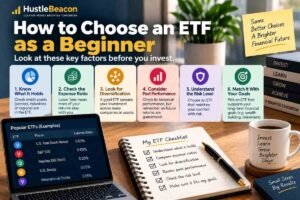
Choosing an ETF should not be based simply on which one has performed best recently.
Instead, consider several important factors.
1. Understand What the ETF Invests In
Before buying an ETF, look at its holdings.
Ask yourself:
What companies or assets does it own?
Which countries does it invest in?
Which industries does it focus on?
Is it heavily concentrated in a few companies?
If you cannot explain what an ETF owns in simple words, take some time to learn about it before investing.
2. Check the Expense Ratio
The expense ratio is the annual operating cost of an ETF expressed as a percentage of your investment.
For example, if an ETF has an expense ratio of 0.10%, the annual fund expenses are approximately $1 for every $1,000 invested, although the actual impact is reflected through the fund’s performance rather than being normally charged as a separate bill.
Lower fees can be helpful, especially when you plan to hold an ETF for many years.
But do not choose an ETF based only on the lowest fee. You should consider the fund’s overall quality, strategy, diversification, liquidity, and tracking performance as well.
3. Look at the Fund’s Holdings
Check how diversified the ETF really is.
An ETF might contain hundreds of companies, but that does not always mean your money is equally spread across all of them.
Some ETFs give much more weight to their largest holdings.
Understanding the holdings can help you know what you are actually investing in.
4. Check the Fund’s Size and Trading Activity
Large ETFs with significant trading activity can often be easier to buy and sell.
You should also pay attention to the bid ask spread, which is the difference between the price buyers are willing to pay and the price sellers are asking.
A smaller spread can reduce the cost of entering or leaving an investment.
5. Understand the Risk
Every investment has risk.
An ETF can lose value, sometimes significantly.
A stock market ETF can fall when stock markets decline. A bond ETF can lose value when interest rates or bond prices move against it. A sector ETF can experience large losses if that particular industry struggles.
Never invest money you cannot afford to leave invested or potentially lose.
How to Invest in ETFs Step by Step
Now let’s look at the actual process.
Step 1: Build Your Financial Foundation
Before investing, make sure your basic financial situation is under control. One important step is having money available for unexpected expenses, so you may want to learn how to build an emergency fund from scratch before putting significant amounts into investments
Try to have enough money available for unexpected expenses and deal with high interest debt before putting significant amounts into investments. If you are struggling with debt, our guide on how to pay off debt faster can help you explore different strategies.
Investing should be part of your overall financial plan, not something you do while ignoring important financial problems.
Step 2: Decide How Much You Can Invest
You do not need thousands of dollars to start learning about investing.
What matters more is choosing an amount that fits comfortably within your budget.
For example, someone might decide to invest $50 every month, while another person may be able to invest $200.
The important thing is that the amount is sustainable.
Step 3: Open a Brokerage Account
To buy ETFs, you generally need an investment or brokerage account that provides access to the market where the ETF trades.
The exact process depends on your country.
When comparing brokers, look at factors such as trading costs, available ETFs, account fees, minimum investment requirements, security features, and the quality of the platform.
If you are investing from outside the United States, make sure you understand the tax rules, currency conversion costs, and investment restrictions that apply to you.
Step 4: Research the ETF
Before placing an order, read the ETF’s information carefully.
Look at:
• What it tracks
• Its holdings
• Expense ratio
• Historical performance
• Risk level
• Dividend policy
• Fund size
• Trading activity
Do not buy an ETF simply because someone recommended it on social media.
Step 5: Decide How Much to Invest
Once you have selected an ETF, decide how much money you want to invest.
Many beginners prefer investing a fixed amount regularly rather than trying to predict the perfect time to buy.
For example, you could invest a set amount every month.
This approach is commonly known as dollar cost averaging.
It means you invest regularly regardless of whether prices are currently high or low.
It does not guarantee profits, but it can make investing more systematic and reduce the temptation to constantly guess where the market is going next.
Step 6: Place Your Order
After choosing your ETF and investment amount, you can place an order through your brokerage account.
There are different types of orders.
A market order generally attempts to buy the ETF at the best available price at that moment.
A limit order allows you to specify the maximum price you are willing to pay.
Beginners should understand how each order works before using it.
Step 7: Keep Investing Consistently
Buying an ETF once is not necessarily an investment strategy.
Long term investing often involves continuing to contribute money while maintaining a diversified portfolio that matches your goals and risk tolerance.
You do not need to check your ETF every few minutes.
Markets move up and down every day. Short term movements are normal.
How Much Money Should a Beginner Invest in ETFs?
There is no single amount that is right for everyone.
If you are unsure how to divide your income between spending, saving, and financial goals, the 50/30/20 budgeting method can give you a simple starting point.
For example, imagine you can comfortably save $300 each month after paying your regular expenses.
You might decide to invest part of that amount and keep the rest for short term goals or emergency savings.
The goal is not to invest as much as possible.
The goal is to build a sustainable habit without putting your everyday financial security at risk.
Common ETF Mistakes Beginners Should Avoid
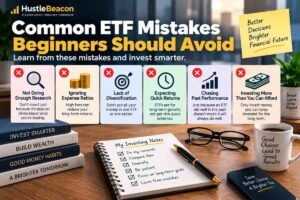
ETFs are relatively simple, but beginners can still make costly mistakes.
Chasing Recent Performance
An ETF that performed extremely well last year may not perform the same way next year.
Past performance does not guarantee future results.
Instead of chasing the ETF with the biggest recent return, focus on whether its investment strategy fits your long term goals.
Investing Without Understanding the ETF
The word ETF does not automatically mean safe.
Some ETFs are highly diversified, while others are extremely concentrated or use complicated strategies.
Always understand what you are buying.
Trying to Time the Market
Many beginners wait for the perfect moment to invest.
The problem is that nobody consistently knows when the market will reach its highest or lowest point.
Trying to predict every market movement can lead to emotional decisions.
A consistent long term strategy can be easier to follow.
Investing Money You Need Soon
Stocks and stock based ETFs can experience significant short term price declines.
If you need your money next month for rent, tuition, a car payment, or another important expense, putting that money into a risky investment may not be appropriate.
Investments should generally match your time horizon.
Ignoring Fees
A fund’s fees may look tiny, but costs can add up over many years.
Always check the expense ratio and any brokerage or currency conversion costs that may apply.
Are ETFs Safe for Beginners?
ETFs themselves are not automatically safe or risky.
The level of risk depends largely on what the ETF invests in.
A broad stock market ETF can still fall significantly during a market downturn.
A bond ETF can also lose value.
A specialized sector ETF may experience even larger swings because it is concentrated in one area.
The important question is not simply whether an ETF is safe.
The better question is whether the ETF’s level of risk is appropriate for your financial goals and ability to handle losses.
A Simple ETF Strategy for Beginners
If you are completely new to investing, you do not need a complicated portfolio.
A simple approach can be easier to understand and maintain.
You might start by researching a broadly diversified ETF that matches your investment goals, risk tolerance, and available market access.
Then you can contribute a manageable amount on a regular schedule.
Over time, you can learn more about investing and adjust your portfolio when there is a genuine reason to do so.
Remember that simple does not mean careless.
You should still research the fund, understand its risks, consider its fees, and make sure it fits your financial situation.
Final Thoughts
Learning how to invest in ETFs for beginners does not have to be complicated.
An ETF can give you access to a collection of investments through a single purchase, making diversification easier than buying many individual investments yourself.
The key is to avoid treating ETFs as a shortcut to quick money.
Start by understanding what an ETF is and what it owns. Choose investments that match your goals and risk tolerance. Pay attention to fees, diversify appropriately, invest money you can leave invested for the long term, and avoid making emotional decisions based on short term market movements.
Most importantly, focus on building good investing habits rather than trying to become rich quickly.
Investing is a long term process. The earlier you learn how it works and develop a sensible strategy, the better prepared you can be to make informed financial decisions.