
Investing can feel complicated when you are just getting started. There are thousands of stocks, bonds, funds, and other investments to choose from, and it can be difficult to know where your money should go.
This is where exchange-traded funds, commonly called ETFs, can make investing easier.
Instead of buying individual stocks one by one, an ETF can give you exposure to a collection of investments through a single fund. By choosing different ETFs that invest across various companies, industries, asset classes, or regions, you can build a portfolio that is more diversified.
But diversification does not mean buying as many ETFs as possible. In fact, owning too many funds can make your portfolio unnecessarily complicated and may cause you to hold the same investments repeatedly.
In this guide, you will learn how to build a diversified ETF portfolio for beginners, how diversification works, what types of ETFs you can consider, how to choose an asset allocation, and how to keep your portfolio simple over time.
What Is an ETF?
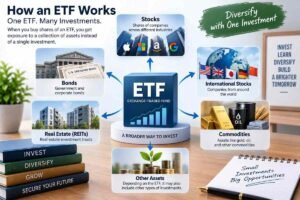
An ETF, or exchange traded fund, is an investment fund that holds a collection of assets and trades on a stock exchange.
The SEC’s Investor.gov provides a detailed explanation of exchange traded funds and how they work.
If you want to learn more about the fundamentals of ETFs, check out this guide on how to invest in ETFs for beginners.
Depending on the ETF, those assets might include stocks, bonds, commodities, or other investments.
For example, instead of buying shares of dozens or hundreds of companies individually, you could buy shares of an ETF that tracks a broad stock market index.
When you buy one share of that ETF, your investment is spread across the securities held by the fund.
This can make ETFs useful for beginners who want diversification without having to research and purchase many individual investments.
However, ETFs are not automatically diversified. Some ETFs focus on a single industry, country, commodity, or narrow group of companies.
That is why you need to look at what an ETF actually owns before adding it to your portfolio.
What Does Diversification Mean?
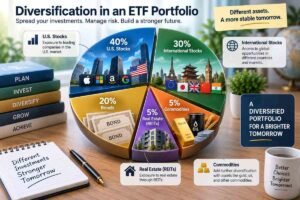
Diversification means spreading your investments across different assets so your portfolio is not dependent on one investment or one area of the market.
The SEC’s Investor.gov also explains how asset allocation and diversification can help investors spread their investments across different assets and manage risk.
Imagine that you invest all your money in a single company.
If that company experiences serious problems, your entire investment could be affected.
Now imagine that your money is spread across hundreds or thousands of companies in different industries.
Problems affecting one company may have a smaller effect on your overall portfolio.
Diversification can also involve different asset classes.
For example, a portfolio might contain:
- Stocks
- Bonds
- International investments
- Other asset classes
The goal is not to eliminate investment risk. Diversification cannot guarantee profits or prevent losses.
Instead, diversification is a way to avoid putting all your investment eggs in one basket.
Why Should Beginners Consider a Diversified ETF Portfolio?
Building a diversified ETF portfolio can provide several potential benefits.
You Can Own Many Investments Through One Fund
A broad ETF may hold hundreds or even thousands of securities.
This means you can gain exposure to many companies without purchasing each one separately.
It Can Make Investing Simpler
Researching individual companies requires time and knowledge.
With broad ETFs, you can potentially build a portfolio using only a few carefully selected funds.
This can make your investment strategy easier to understand and maintain.
It Can Spread Risk
If one company performs poorly, its impact on a broadly diversified fund may be smaller than it would be if you owned only that company.
However, remember that broad stock ETFs can still fall significantly during market declines.
It Can Support a Long Term Strategy
Many investors use diversified ETFs as part of a long term investment strategy.
Instead of trying to predict which individual company will perform best next month, an investor can focus on owning a broad group of investments and staying consistent.
How to Build a Diversified ETF Portfolio
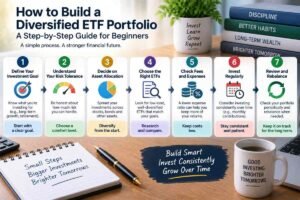
Now let’s look at the practical process.
You do not need dozens of ETFs to build a diversified portfolio. For many beginners, a small number of broad funds may be enough.
Step 1: Define Your Investment Goal
Before choosing an ETF, understand why you are investing.
Your goal could be:
- Building long term wealth
- Saving for retirement
- Investing for a future financial goal
- Growing money over many years
- Creating a long term investment portfolio
Your goal matters because it influences how much risk you may be willing and able to take.
Someone investing for a goal many years away may have different considerations from someone who expects to need the money soon.
Do not choose an investment simply because it has performed well recently.
If your long term goal is retirement, you can also learn more about how to invest for retirement as a beginner and how your investment timeframe can affect your strategy.
Start with your goal.
If you’re completely new to investing, it can also help to understand the basics of investing for beginners before choosing specific ETFs.
Step 2: Understand Your Risk Tolerance
Risk tolerance refers to how comfortable you are with the possibility of losing money or seeing your investment value decline.
For example, imagine you invest in a stock ETF and the market falls sharply.
Would you panic and sell immediately?
Or could you remain invested while understanding that markets can fluctuate?
Your emotional reaction matters because an investment strategy only works if you can stick with it.
You should also consider your risk capacity, which is your financial ability to handle losses.
These are not always the same thing.
Someone may feel comfortable with high risk but still have a short investment timeframe that makes large losses particularly difficult to handle.
Step 3: Decide on Your Asset Allocation
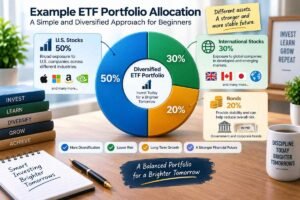
Asset allocation means deciding how your portfolio is divided among different types of investments.
A simple portfolio might contain:
- Stocks
- Bonds
A more diversified portfolio could include domestic stocks, international stocks, and bonds.
For example, a hypothetical portfolio might look like this:
| Asset Type | Example Allocation |
|---|---|
| Broad U.S. stocks | 50% |
| International stocks | 30% |
| Bonds | 20% |
This is only an example, not a recommendation.
The appropriate allocation depends on your goals, timeframe, risk tolerance, financial situation, and other factors.
The key lesson is that asset allocation should come before randomly choosing ETFs.
Step 4: Choose Broad ETFs
Once you understand your desired asset allocation, look for ETFs that provide broad exposure.
For example, you might research ETFs covering:
- A broad domestic stock market
- International stocks
- Bonds
- Other asset classes that fit your strategy
A broad-market ETF can potentially give you exposure to many securities through one investment.
When comparing ETFs, look beyond the name.
Check what the fund actually holds and what index or strategy it follows.
Step 5: Check the ETF’s Expense Ratio
An expense ratio is the annual operating cost charged by an ETF, expressed as a percentage of the fund’s assets.
For example, if an ETF has a 0.10% expense ratio, the annual fund expenses are approximately 0.10% of the assets invested in the fund.
Costs matter because investment expenses reduce your returns over time.
The SEC explains that ETF fees and expenses can reduce investment returns over time, so investors should understand and compare the costs of different funds.
However, the cheapest ETF is not automatically the best choice.
You should consider the overall fund, including its strategy, diversification, tracking performance, liquidity, and costs.
Step 6: Check What the ETF Actually Owns
This is one of the most important steps beginners often overlook.
Two ETFs may appear different but hold many of the same companies.
For example, imagine you own:
ETF A: Broad U.S. stock market
ETF B: Large U.S. companies
ETF B may contain many of the same companies already included in ETF A.
Adding both does not necessarily provide as much additional diversification as you might expect.
Before buying an ETF, look at:
- Top holdings
- Number of holdings
- Geographic exposure
- Industry exposure
- Asset class
- Investment strategy
This helps you understand what you actually own.
How Many ETFs Should a Beginner Own?
There is no magic number.
A beginner could potentially build a diversified portfolio with just a few broad ETFs.
For example, a simple portfolio might contain:
- A broad domestic stock ETF
- An international stock ETF
- A bond ETF
Another investor might prefer a single diversified fund that already combines several asset classes.
The important thing is not the number of ETFs.
The goal is meaningful diversification, not maximum complexity.
Owning 15 ETFs does not automatically make your portfolio more diversified than owning three well chosen broad funds.
ETFs aren’t the only way to gain exposure to stocks. Some investors also research individual companies and dividend stocks for beginners as part of their broader investing education.
Example of a Simple Diversified ETF Portfolio
Let’s look at a hypothetical example.
Suppose a beginner wants a portfolio containing stocks and bonds.
They could research a structure such as:
| Portfolio Component | Purpose |
|---|---|
| Broad domestic stock ETF | Exposure to domestic companies |
| International stock ETF | Exposure to companies outside the home market |
| Bond ETF | Exposure to bonds and potential portfolio stability |
The investor could then choose an allocation based on their personal circumstances.
For example:
60% stocks + 40% bonds
or
80% stocks + 20% bonds
These are examples only.
A younger investor with a long investment horizon may have different considerations from someone approaching retirement or saving for a near-term goal.
Do not copy an allocation simply because someone online uses it.
Should You Include International ETFs?
International diversification can help reduce your dependence on a single country’s economy.
For example, someone whose portfolio is entirely invested in companies from one country is exposed to that country’s economic conditions, market environment, currency, and political developments.
An international ETF can provide exposure to companies in other countries or regions.
However, international investing introduces additional considerations, including currency movements, geopolitical risks, and differences between markets.
You should understand what geographic exposure an ETF provides before investing.
Should You Include Bond ETFs?
Bond ETFs can provide exposure to a collection of bonds through one fund.
Some investors use bonds to diversify a portfolio that is heavily focused on stocks.
Bond ETFs can differ significantly from one another.
For example, they may invest in:
- Government bonds
- Corporate bonds
- Short term bonds
- Long term bonds
- Different credit quality bonds
- Bonds from different countries
Because these funds behave differently, do not assume every bond ETF serves the same purpose.
How to Rebalance Your ETF Portfolio
Your portfolio’s allocation can change over time because different investments grow at different rates.
Imagine your target allocation is:
70% stocks and 30% bonds.
After several years, stocks perform strongly and your portfolio becomes:
80% stocks and 20% bonds.
Your portfolio is now taking more stock-market exposure than your original plan intended.
Rebalancing means bringing the portfolio back toward your target allocation.
You might do this periodically or when your allocation moves significantly away from your target.
There is no universal rebalancing schedule that works for everyone.
The important thing is to have a plan and avoid making frequent emotional changes based on short-term market movements.
Should You Invest in ETFs All at Once or Gradually?
There are different approaches to investing.
Some investors invest a larger amount at once, while others contribute smaller amounts regularly.
Regular investing can make it easier to develop a consistent habit.
For example, you could decide to invest a certain amount from your income each month rather than trying to guess the perfect time to enter the market.
This approach is sometimes called dollar cost averaging when a fixed amount is invested at regular intervals.
It does not guarantee profits and does not eliminate market risk.
The important thing is to choose an approach that fits your financial situation and allows you to remain consistent.
Before investing money you may need for unexpected expenses, make sure you understand the importance of building an emergency fund and keeping short term financial needs separate from long term investments.
Common ETF Investing Mistakes Beginners Should Avoid
Buying Too Many ETFs
More ETFs do not automatically mean better diversification.
Too many funds can make your portfolio difficult to understand and may create unnecessary overlap.
Chasing Recent Performance
An ETF that performed extremely well recently may attract attention.
But past performance does not guarantee future results.
Avoid choosing an ETF simply because it was one of the year’s top performers.
Ignoring Fees
Small costs can compound over long periods.
Compare expense ratios and other relevant costs before investing.
Investing Money You Need Soon
Stock ETFs can experience significant price declines.
Money needed for an upcoming expense generally requires different considerations from money intended for a long-term goal.
Make sure your investment timeframe matches the risk of the investments you choose.
Constantly Changing Your Portfolio
Checking your portfolio every day can encourage emotional decisions.
Markets move up and down.
A long-term strategy generally requires patience and discipline rather than constant changes.
How to Keep Your ETF Portfolio Simple
A simple portfolio is easier to understand, monitor, and maintain.
Here are some practical rules beginners can follow:
Know what you own. Read the ETF’s description and examine its holdings.
Avoid unnecessary overlap. Check whether multiple ETFs own many of the same companies.
Keep costs in mind. Compare expense ratios and other relevant costs.
Diversify across meaningful areas. Think about companies, regions, industries, and asset classes.
Invest according to your goals. Your portfolio should have a purpose.
Review periodically. You do not need to watch your investments every hour.
Stay patient. Long term investing is different from trying to make quick profits.
Is a Diversified ETF Portfolio Risk Free?
No.
This is one of the most important things beginners need to understand.
Diversification can reduce the impact of a single investment performing poorly, but it cannot eliminate market risk.
If the overall stock market falls, a broad stock ETF can also fall.
Bond funds can decline as well, depending on interest rates, credit conditions, and the types of bonds they hold.
Your investments can lose value.
That is why you should understand the risks before investing and avoid putting money into the market that you cannot afford to lose or may need in the short term.
Final Thoughts
Learning how to build a diversified ETF portfolio for beginners does not have to be complicated.
Start with your financial goal, understand your investment timeframe, consider your risk tolerance, and decide how you want to divide your portfolio among different asset classes.
From there, look for broad ETFs that provide meaningful diversification and pay attention to costs, holdings, geographic exposure, and overlap between funds.
You do not need dozens of ETFs to create a diversified portfolio. A small number of carefully selected funds can potentially provide broad exposure while keeping your investment strategy easier to manage.
Most importantly, remember that diversification does not eliminate risk, and ETFs are not guaranteed investments. Markets can decline, and the value of your portfolio can fluctuate.
The goal is not to build the most complicated portfolio.
The goal is to build a portfolio you understand, that matches your financial goals, and that you can realistically stick with for the long term.