

Planning for retirement can feel like something you only need to worry about when you are older. But the earlier you start investing, the more time your money has to potentially grow.
You do not need to be wealthy or understand complicated financial terms to begin. What matters is having a clear plan, investing consistently, and giving your investments enough time to work.
Retirement investing is different from saving money for a short term goal. Your retirement may be decades away, which gives you a longer time horizon. This allows you to consider investments that have the potential for higher long-term growth, while understanding that they can also rise and fall in value.
In this guide, you will learn how to invest for retirement as a beginner, how much you may need, which types of investments you can consider, how compound growth works, and the common mistakes you should avoid.
What Is Retirement Investing?
Retirement investing means putting money into investments with the goal of building wealth for your future retirement.
Instead of keeping all your retirement money in cash, you invest some of it in assets that may grow over many years.
Depending on where you live and what investment accounts are available, you may be able to invest through retirement specific accounts, employer sponsored plans, individual investment accounts, or other suitable investment options.
Common investments include:
- Stocks
- Bonds
- Mutual funds
- Exchange traded funds (ETFs)
- Target date funds
- Other diversified investments
The purpose is not to find one investment that will make you rich quickly.
The goal is to build a diversified portfolio that matches your retirement timeline, financial situation, and ability to handle investment risk.
Why Should You Start Investing for Retirement Early?
Time is one of the biggest advantages available to a retirement investor.
When you invest money and earn a return, those returns can potentially generate additional returns in the future. This is known as compound growth.
For example, imagine you invest money regularly for several decades. Your original contributions may grow, and the returns earned along the way can also become part of your investment.
This is why starting early can be powerful.
Someone who starts investing in their twenties has more time for their investments to potentially grow than someone who starts in their forties or fifties.
Starting early does not guarantee investment success. Markets can fall, investments can lose value, and future returns are uncertain.
However, having more time can give you greater opportunity to benefit from long term growth.
How to Invest for Retirement as a Beginner
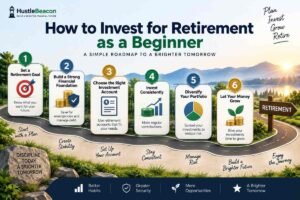
You do not need a complicated retirement strategy when you are just starting.
A simple process can help you build good habits and avoid unnecessary mistakes.
Step 1: Set a Retirement Goal
Before choosing investments, think about what you want your retirement to look like.
You do not need to know the exact amount you will need decades from now. Start by thinking about basic questions.
Ask yourself:
- At what age would I like to retire?
- What kind of lifestyle do I want?
- Where might I live?
- Will I have other sources of income?
- What expenses might I have?
- How long might my retirement last?
Your answers can help you understand how much you may need to save and invest.
Your retirement goal does not have to be perfect. You can update it as your income, family situation, and financial priorities change.
Step 2: Build a Strong Financial Foundation
Retirement investing should not come at the expense of your basic financial stability.
Before investing aggressively, make sure you have money available for unexpected expenses.
An emergency fund can help you handle situations such as a job loss, urgent repair, or unexpected bill without immediately selling investments.
You should also pay attention to expensive debt.
High interest debt can make it difficult to build wealth because a large portion of your money may be going toward interest, so learning how to pay off debt faster may help strengthen your financial foundation.
If you are still building your emergency savings or dealing with expensive debt, you may want to balance those priorities before putting large amounts of money into long term investments.
The exact order depends on your personal situation, but the important point is to build a stable financial foundation.
Step 3: Take Advantage of Employer Retirement Plans
If your employer offers a retirement plan, learn how it works.
Some employers provide contributions or matching programs based on how much you contribute.
For example, an employer may contribute additional money when you contribute to the retirement plan.
If an employer match is available, understand the rules and requirements. It can be an important part of your overall retirement strategy.
Check:
- How much you can contribute
- Whether your employer provides matching contributions
- How employer contributions work
- What investment choices are available
- What fees are charged
- What happens if you leave the company
Retirement plans vary significantly between countries and employers, so always understand the specific rules that apply to you.
Step 4: Choose the Right Investment Account
The account you use can be just as important as the investments you choose.
Different countries offer different retirement and investment accounts.
Some accounts may provide tax advantages, while others may have different withdrawal rules or contribution limits.
Before opening an account, understand:
- Contribution limits
- Tax treatment
- Withdrawal rules
- Investment choices
- Account fees
- Employer contributions
- Penalties or restrictions
If you are unsure about the rules in your country, use information from your government, tax authority, or a regulated financial institution rather than relying on social media advice.
Step 5: Choose Investments You Understand
Once your retirement account is ready, you need to decide what to invest in.
Beginners often make the mistake of searching for the investment that will produce the highest return.
If you are completely new to investing, our guide on how to start investing as a beginner can help you understand the basics before choosing specific investments.
That approach can lead to unnecessary risk.
Instead, focus on investments that you understand and that fit your long term plan.
Common choices include stocks, bonds, mutual funds, and ETFs.
Stocks can provide strong long term growth potential, but their prices can move significantly.
Bonds are generally designed to provide income and stability, although they also carry risks.
Diversified funds and ETFs can hold many different investments inside one fund, making diversification easier for beginners.
The right combination depends on factors such as your age, retirement timeline, financial goals, and risk tolerance.
Step 6: Understand Asset Allocation
Asset allocation means deciding how your money is divided among different types of investments.
For example, a portfolio might contain a combination of stocks and bonds.
Stocks generally provide greater growth potential but can experience larger price movements.
Bonds can provide diversification and may be less volatile than stocks in some situations, although they are not risk free.
A younger investor with several decades until retirement may be able to tolerate more short term market volatility than someone who is close to retirement.
There is no single asset allocation that is perfect for everyone.
Your allocation should reflect your personal circumstances and investment timeline.
Step 7: Diversify Your Retirement Portfolio

Diversification means spreading your investments rather than putting all your money into one company, industry, or asset.
Imagine putting your entire retirement portfolio into one company’s stock.
If that company experiences serious problems, a large portion of your retirement savings could be affected.
A diversified portfolio can reduce the impact of one investment performing badly.
You can diversify across:
- Companies
- Industries
- Countries
- Asset classes
- Investment types
Diversified ETFs and mutual funds can make this easier because one fund may hold many different investments.
However, diversification does not eliminate risk. A diversified portfolio can still lose value when markets decline.
Step 8: Invest Consistently
Consistency is one of the most useful habits a beginner can develop.
Instead of investing only when you feel confident about the market, consider contributing regularly.
For example, you might invest a portion of your income every month.
This approach can help you develop discipline and reduce the temptation to constantly predict whether the market will rise or fall.
You will sometimes invest when prices are high and sometimes when prices are lower.
The important part is following a long term plan instead of making decisions based entirely on short term market movements.
Step 9: Reinvest Your Investment Earnings
If your investments produce dividends, interest, or other distributions, you may have the option to reinvest them.
Reinvesting means using those earnings to purchase additional investments instead of taking the money as cash.
Over many years, those additional investments can potentially produce more earnings.
This can strengthen the effect of compound growth.
Not every investor needs to reinvest everything. Your approach may change as you get closer to retirement and begin using your investments to support your living expenses.
How Much Should You Invest for Retirement?
There is no universal percentage that works for everyone.
The amount you should invest depends on:
- Your income
- Your age
- Your retirement goal
- Your expected retirement age
- Your current savings
- Your debt
- Your living expenses
- Your investment returns
- Your expected retirement income
If you are unsure how to divide your income between spending, saving, and financial goals, the 50/30/20 budgeting method can provide a simple starting point.
If you are young and just starting, do not become discouraged because your contributions seem small.
Increasing your contributions gradually can make investing easier.
For example, whenever your income increases, you could consider increasing the amount you invest.
The most important thing is to start with an amount that is realistic for your current financial situation.
What Should Beginners Invest in for Retirement?
There are several investment options beginners may encounter.
Stocks
Stocks represent ownership in companies.
They can provide significant long term growth potential, but stock prices can fall substantially.
For retirement investors with a long time horizon, stocks may play an important role in a diversified portfolio.
Bonds
Bonds are investments that generally involve lending money to a government, company, or other issuer.
In return, the investor may receive interest according to the terms of the bond.
Bonds can provide diversification, although they still carry risks such as interest rate risk and credit risk.
ETFs
ETFs are investment funds that trade on stock exchanges.
Many ETFs hold a collection of stocks, bonds, or other investments.
For beginners, diversified ETFs can be useful because they can provide exposure to many investments through a single fund.
However, always check what an ETF actually owns, what it costs, and how it fits into your overall portfolio.
Mutual Funds
Mutual funds pool money from many investors and use that money to purchase investments.
Some mutual funds are actively managed, while others track a specific market index.
Before investing, check the fund’s investment strategy, fees, performance history, and level of diversification.
Target Date Funds
Target date funds are designed around an expected retirement year.
They typically adjust their investment mix as the target date approaches.
These funds can be convenient for beginners who want a simpler approach, but you should still understand their fees, investment strategy, and risk level.
How Compound Growth Can Help Your Retirement

Compound growth is one of the most important concepts to understand when investing for retirement.
Suppose your investments earn returns over time.
Instead of only earning returns on your original contributions, you may eventually earn returns on previous returns as well.
The longer this process continues, the more powerful it can potentially become.
This is why time matters so much.
You cannot control exactly what the market will return each year. But you can control how early you start, how consistently you contribute, how much you save, and how you manage your investment costs.
Should You Invest More as You Get Older?
Ideally, your retirement contributions can increase as your financial situation improves.
When your income rises, consider increasing your retirement contributions instead of allowing your lifestyle expenses to increase by the same amount.
You can also review your investment portfolio periodically.
Your investment strategy may need to change as you get closer to retirement.
An investor with decades remaining may have more time to recover from market declines.
Someone approaching retirement may have less time to recover from a major loss.
This is one reason asset allocation often becomes more important as retirement gets closer.
Common Retirement Investing Mistakes Beginners Should Avoid
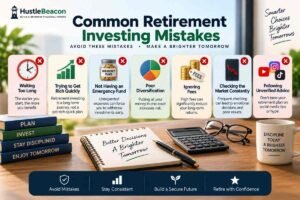
Waiting Too Long to Start
One of the biggest mistakes is believing you need to wait until you earn more money.
Starting with a small amount can be better than waiting indefinitely for the perfect financial situation.
You can increase your contributions later.
Trying to Get Rich Quickly
Retirement investing is a long term process.
Trying to double your money quickly can push you toward unnecessary risks, speculative investments, or scams.
Focus on steady progress rather than overnight wealth.
Investing Without an Emergency Fund
If you have no emergency savings, an unexpected expense could force you to sell investments at an inconvenient time.
Building some financial flexibility can make long term investing easier.
Putting Everything Into One Investment
Even an investment that looks excellent today can perform poorly in the future.
Diversification can help reduce the damage caused by one investment performing badly.
Ignoring Investment Fees
Small fees can have a significant effect over long periods.
Before investing in a fund or account, understand the costs involved.
Look at management fees, transaction costs, account fees, and other charges.
Constantly Checking the Market
Retirement investing is usually a long term activity.
Checking your portfolio every few minutes will not make you a better investor.
Frequent market movements are normal.
Focus on your overall plan rather than reacting emotionally to every market decline.
Following Social Media Investment Tips
Social media can provide useful educational information, but it can also contain misleading financial advice.
Be especially careful with anyone promising guaranteed returns, quick wealth, or secret investments.
Research an investment yourself and use reliable sources before making financial decisions.
How to Build a Simple Retirement Investing Plan
If you are starting from zero, your plan does not need to be complicated.
Start with these seven steps:
1. Set a retirement goal.
Think about when you want to retire and the lifestyle you want.
2. Build an emergency fund.
Create financial protection for unexpected expenses.
3. Deal with expensive debt.
High-interest debt can make wealth building more difficult.
4. Choose an appropriate retirement account.
Understand the tax benefits, limits, fees, and withdrawal rules.
5. Build a diversified portfolio.
Choose investments that match your time horizon and risk tolerance.
6. Invest regularly.
Make retirement investing a habit rather than something you do occasionally.
7. Review your plan periodically.
Check your contributions, investment allocation, fees, and retirement progress.
You do not need to make major changes every month.
A simple plan that you can follow for years can be more useful than a complicated strategy that you constantly change.
When Should You Change Your Retirement Investments?
You should not change your investments simply because the market has a bad week or month.
Instead, consider reviewing your portfolio when your circumstances change.
For example:
- Your retirement date gets closer
- Your income changes significantly
- Your financial goals change
- Your risk tolerance changes
- Your investment fees become too high
- Your portfolio becomes significantly unbalanced
Regular reviews can help you stay aligned with your retirement plan without encouraging unnecessary trading.
Final Thoughts
Learning how to invest for retirement as a beginner does not require you to become a financial expert.
The most important steps are simple.
Start as early as you reasonably can, build a strong financial foundation, choose an appropriate retirement account, invest in diversified assets, contribute consistently, and give your investments time to grow.
Do not focus on finding the perfect stock or predicting what the market will do next.
Your retirement strategy should be built around your long term goals, financial situation, and ability to handle risk.
Most importantly, remember that investing involves risk. Investments can lose value, and past performance does not guarantee future results.
You do not need to have everything figured out before you begin.
Start with what you understand, keep learning, and gradually improve your strategy as your financial situation develops.
The earlier you build the habit of investing for retirement, the more time you give yourself to potentially build financial security for the future.