
Investing in companies from countries outside your home market can give your portfolio exposure to different economies, industries, and growth opportunities. But buying individual stocks in unfamiliar markets can be complicated, especially when you are just getting started.
This is one reason emerging market ETFs can be useful for beginner investors.
Instead of researching and buying individual companies from several developing economies, an emerging market ETF can give you exposure to a collection of companies through a single investment. Depending on the fund, that exposure may include companies from countries across Asia, Latin America, Eastern Europe, Africa, and other emerging regions.
However, emerging markets also come with additional risks. Currency movements, political changes, economic conditions, market volatility, and differences in regulations can affect your investment.
So how do you actually get started?
In this guide, you will learn how to invest in emerging market ETFs for beginners, how these ETFs work, what to look for before investing, the risks you should understand, and how emerging market ETFs can fit into a diversified portfolio.
What Are Emerging Market ETFs?

An emerging market ETF is an exchange traded fund that invests in companies or other securities from emerging market economies.
An ETF holds a collection of investments and trades on a stock exchange, similar to an individual stock.
Instead of buying shares of one company in an emerging market, you can buy shares of an ETF that may hold hundreds of companies across multiple countries.
For example, an emerging market ETF might provide exposure to companies in countries such as India, Taiwan, Brazil, Mexico, South Africa, or other markets classified as emerging.
The exact countries and companies depend on the ETF and the index or investment strategy it follows.
This makes it important to look at the fund’s holdings before investing.
If you’re new to ETFs, learning how to invest in ETFs for beginners can help you understand how these funds work before exploring emerging markets.
What Makes a Market an Emerging Market?
The term emerging market generally refers to an economy that is developing and becoming more integrated with the global financial system but does not yet have all the characteristics of a highly developed market.
Emerging markets can differ significantly from one another.
Some may have rapidly growing populations, expanding industries, increasing consumer spending, or developing financial systems.
Others may have more established companies but still face greater economic or market risks than developed markets.
There is no single characteristic that makes every country an emerging market. Different index providers and financial institutions can use different classifications.
This is another reason to check the specific countries included in an ETF instead of assuming that every emerging market fund is the same.
How Do Emerging Market ETFs Work?
The basic process is similar to investing in other ETFs.
Suppose an emerging market ETF tracks an index containing hundreds of companies from several countries.
When you purchase shares of that ETF, your money gives you exposure to the collection of investments held by the fund.
ETFs can provide ETF diversification by giving investors exposure to multiple companies or industries through a single fund, although some ETFs are more narrowly focused.
You do not need to purchase shares of every company individually.
The ETF may hold companies from industries such as:
- Technology
- Financial services
- Consumer goods
- Energy
- Healthcare
- Telecommunications
- Industrial companies
The exact composition changes depending on the fund.
Some ETFs are broad and cover many countries and industries, while others focus on a particular region, country, sector, or investment theme.
Why Invest in Emerging Market ETFs?
Emerging market ETFs can provide diversification beyond your home country’s stock market.
The SEC’s Investor.gov explains that international investing can provide diversification and exposure to potential growth in foreign economies, including emerging markets.
Exposure to Different Economies
If your portfolio is concentrated in one country, an emerging market ETF can give you exposure to companies operating in different economies.
This does not eliminate risk, but it can make your overall portfolio less dependent on one country’s market.
Access to Multiple Countries
Buying individual stocks across several foreign markets can be complicated.
An ETF can provide access to multiple countries through a single fund.
This makes international diversification more accessible to beginners.
Exposure to Developing Companies
Some emerging economies have expanding consumer markets, growing businesses, and developing industries.
Investors may want exposure to these economies because of their potential for long term economic development.
However, economic growth does not automatically mean that stock prices will rise.
A country’s economy can grow while individual companies or its stock market perform poorly.
Simple Portfolio Construction
Instead of researching dozens of foreign companies, an investor can research one broad ETF and understand its overall strategy.
This can make international investing easier to manage.
How to Invest in Emerging Market ETFs

If you are a beginner, you can approach the process step by step.
Step 1: Understand Why You Want Emerging Market Exposure
Before choosing an ETF, ask yourself why you want emerging market exposure.
You might want to:
- Diversify your existing portfolio
- Gain international exposure
- Invest in companies outside developed markets
- Add geographic diversification
- Build a long term investment portfolio
Knowing your purpose makes it easier to choose an appropriate type of ETF.
Do not buy an emerging market ETF simply because you saw that it recently performed well.
Start with your overall investment plan.
If you’re still learning the fundamentals of investing, start with the basics of investing for beginners before deciding which types of ETFs belong in your portfolio.
Step 2: Check Your Investment Time Horizon
Your investment time horizon is the amount of time you expect to keep your money invested.
Emerging market investments can experience significant price movements.
If you may need your money soon, a volatile stock ETF may not be appropriate for that particular goal.
Long term investing generally gives you more time to potentially recover from temporary market declines, although there is no guarantee that an investment will recover or produce a profit.
Before investing, make sure you understand when you might need the money.
Your investment timeframe becomes especially important when you’re investing for a long term goal such as retirement, so you may also want to learn how to invest for retirement as a beginner.
Step 3: Choose a Broad or Focused ETF
One of the first decisions is whether you want broad emerging market exposure or a more focused investment.
A broad emerging market ETF may invest across several countries and industries.
A focused ETF might concentrate on:
- One country
- One region
- A specific industry
- A particular group of companies
- A specific investment strategy
For beginners, understanding this distinction is important.
A broad ETF may provide wider diversification, while a focused ETF can create greater exposure to a particular market or theme.
Neither structure is automatically appropriate for every investor.
Step 4: Check the Countries Included
Do not buy an emerging market ETF without checking its geographic exposure.
Two ETFs with similar names can have different country allocations.
Look at the fund’s current holdings and country breakdown.
For example, you may discover that one ETF has a large allocation to a few countries while another spreads its investments more evenly.
Also remember that country weights can change over time.
Checking the fund periodically helps you understand what you actually own.
Step 5: Look at the ETF’s Holdings
After checking the countries, examine the companies inside the fund.
Look at:
- Number of holdings
- Largest companies
- Industry exposure
- Country exposure
- Market capitalization
- Investment strategy
This can reveal whether the ETF is genuinely diversified or heavily concentrated in a few companies or sectors.
For example, an ETF might contain hundreds of companies but still have a large percentage of its assets invested in its biggest holdings.
The number of holdings alone does not tell you everything about diversification.
Step 6: Compare Expense Ratios
An ETF charges expenses for operating the fund.
The expense ratio expresses the fund’s annual operating expenses as a percentage of its assets.
Costs are important because they reduce the return you keep from your investment.
When comparing similar emerging market ETFs, look at their expense ratios and other relevant costs.
But do not choose a fund based only on the lowest expense ratio.
Also consider:
- Investment strategy
- Index tracked
- Diversification
- Fund size
- Liquidity
- Tracking performance
- Geographic exposure
A slightly higher cost may sometimes be associated with a different strategy or structure.
When comparing funds, pay close attention to ETF fees and expenses, because even relatively small costs can reduce your investment returns over time.
The key is understanding what you are paying for.
Step 7: Understand Currency Risk
Currency is an important part of international investing.
Imagine you invest in companies whose shares are priced in currencies different from your own.
Changes in exchange rates can affect the value of your investment when converted back into your home currency.
For example, even if the underlying companies perform reasonably well, a significant currency movement can affect your return when measured in your local currency.
Some ETFs may use currency hedging strategies, while others do not.
Check the fund’s documentation to understand how currency exposure is handled.
Step 8: Check How the ETF Is Structured
Before investing, understand the basic structure of the ETF.
Look at:
- The index it follows
- Whether it physically holds securities or uses another method
- Fund domicile
- Distribution policy
- Trading exchange
- Currency
- Fund size
- Expense ratio
These details can matter, particularly for investors outside the fund’s home country.
If you are investing internationally, tax rules and regulations can also differ depending on where you live and where the fund is domiciled.
Before investing, review the ETF’s prospectus and investment information to understand the fund’s strategy, risks, costs, and holdings.
For beginners, this is an area where professional financial or tax advice may be useful.
How Much of Your Portfolio Should Be in Emerging Markets?
There is no universal percentage that works for everyone.
Your allocation depends on your goals, risk tolerance, investment timeframe, existing portfolio, and financial circumstances.
For example, suppose someone already owns a broad domestic stock ETF and wants additional international diversification.
They might consider whether an emerging market ETF complements their existing international exposure.
Another investor may already have significant exposure to emerging markets through an international fund.
In that case, adding a separate emerging market ETF could increase exposure more than they realize.
This is why you should look at your entire portfolio rather than evaluating each ETF in isolation.
Emerging Market ETF vs International ETF
These two terms are related but not identical.
An international ETF can provide exposure to companies outside your home country.
Depending on the fund, it might include developed markets, emerging markets, or both.
An emerging market ETF specifically focuses on markets classified as emerging.
For example, a broad international ETF could contain companies from developed economies as well as emerging economies, while an emerging market ETF would concentrate on the latter.
Before buying either one, check the fund’s country allocation.
This can help you avoid accidentally buying overlapping investments.
What Are the Risks of Emerging Market ETFs?
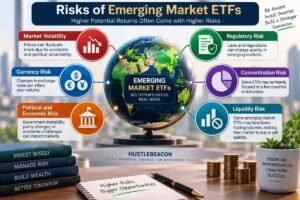
Investors should understand the risks of investing in emerging markets, including political, regulatory, legal, liquidity, currency, and market volatility risks.
Emerging market ETFs can provide diversification, but they also have meaningful risks.
Market Volatility
Emerging markets can experience significant price swings.
Your ETF may rise or fall substantially over relatively short periods.
Currency Risk
Changes in exchange rates can affect the value of your investment when converted into your home currency.
Political and Economic Risk
Changes in government policy, political conditions, economic growth, trade rules, or regulations can affect companies operating in emerging markets.
Regulatory Differences
Financial regulations and reporting standards can differ from those in developed markets.
This can make comparing companies more difficult.
Concentration Risk
Some emerging market indexes can be heavily concentrated in particular countries, industries, or large companies.
Always check the fund’s current allocation.
Liquidity Risk
Some securities in emerging markets may be less liquid than securities in major developed markets.
This can sometimes make buying or selling investments more difficult or expensive.
Higher Overall Risk
Emerging market ETFs can be more volatile than broad developed market investments.
Diversification helps spread exposure, but it does not eliminate investment risk.
How to Add Emerging Market ETFs to a Diversified Portfolio

An emerging market ETF usually works best when you understand how it fits with your other investments.
For example, imagine a hypothetical portfolio containing:
- Domestic stock ETF
- Developed international stock ETF
- Emerging market ETF
- Bond ETF
Each component can serve a different role.
The domestic stock ETF provides exposure to companies in your home market.
The developed international ETF provides exposure to companies in developed foreign markets.
The emerging market ETF adds exposure to emerging economies.
The bond ETF provides exposure to bonds.
This is only an example. Your actual portfolio should reflect your personal goals and circumstances.
How to Avoid Overlapping Investments
One common mistake is assuming that every ETF provides completely different exposure.
Imagine you own a broad international ETF.
That fund may already contain emerging market companies.
If you then add a dedicated emerging market ETF, you are increasing your exposure to those markets.
That may be intentional, but you should understand it.
Before purchasing another ETF, check:
- Which countries does it hold?
- Which companies are its largest holdings?
- Which industries does it cover?
- Do I already own these companies through another fund?
- Will this purchase significantly change my portfolio allocation?
These questions can help you avoid accidental concentration.
Should Beginners Invest in Emerging Market ETFs?
Beginners can learn about emerging market ETFs as part of building an internationally diversified portfolio, but they should understand the additional risks before investing.
You do not need to invest in emerging markets simply because they are popular or because someone online says they offer strong growth potential.
Start by understanding your overall portfolio.
If you already have broad international exposure, you may already own emerging market companies indirectly.
If you decide to add a dedicated emerging market ETF, understand why you are adding it and what percentage of your portfolio it represents.
How to Monitor Your Emerging Market ETF
You do not need to watch your ETF every day.
Instead, review it periodically.
Check whether:
- The fund still follows its stated strategy
- Country allocations have changed significantly
- Major holdings have changed
- Fees have changed
- The fund still fits your portfolio
- Your overall allocation remains close to your target
Avoid making decisions based solely on short term price movements.
A long term investment strategy requires patience.
ETFs are one way to gain stock market exposure, while some investors also choose individual investments such as dividend stocks for beginners as part of their investing education.
Common Mistakes Beginners Should Avoid
Chasing High Returns
An emerging market ETF that performed strongly in the past may not continue doing so.
Past performance does not guarantee future results.
Ignoring Country Concentration
A fund labeled as an emerging market ETF may still have significant exposure to a small number of countries.
Check the actual allocation.
Forgetting About Currency Risk
International returns can be affected by currency movements.
Do not evaluate foreign investments only by looking at local market performance.
Investing Without Understanding Your Existing Portfolio
You may already have emerging market exposure through another international ETF.
Review your current holdings before adding another fund.
Panicking During Market Declines
Emerging markets can be volatile.
Selling during a sharp decline can turn a temporary loss into a permanent one.
Your investment strategy should be designed around your goals and risk tolerance rather than short term market emotions.
A Simple Checklist Before Buying an Emerging Market ETF
Before purchasing an emerging market ETF, ask yourself:
What does this ETF track?
Understand the index or investment strategy.
Which countries does it hold?
Check the geographic breakdown.
Which companies are its largest holdings?
Understand concentration.
What industries does it cover?
Look beyond the country allocation.
What is the expense ratio?
Compare costs with similar funds.
What currency risks exist?
Understand how exchange rates may affect your investment.
Does it overlap with my current investments?
Check your entire portfolio.
Why am I buying it?
Have a clear reason instead of following a trend.
Can I handle the volatility?
Make sure the investment matches your risk tolerance and timeframe.
Final Thoughts
Learning how to invest in emerging market ETFs for beginners starts with understanding what you are actually buying.
An emerging market ETF can provide exposure to companies across multiple developing economies through a single investment. This can make international diversification easier than researching and purchasing individual foreign stocks.
However, emerging markets come with additional risks, including market volatility, currency movements, political and economic changes, regulatory differences, and potential concentration in certain countries or industries.
Before investing, look at the ETF’s index, holdings, country allocation, expense ratio, currency exposure, and overlap with your existing investments.
Most importantly, think about how the ETF fits into your overall portfolio, rather than treating it as a standalone investment.
You do not need to predict which emerging market will perform best. A better starting point is to understand your goals, build a diversified approach that fits your circumstances, and choose investments you can realistically hold through periods of market uncertainty.
Emerging market ETFs can be an interesting part of a diversified long term portfolio, but they should be approached with a clear understanding of both their potential benefits and their risks.