
Budgeting can completely change the way you manage your money, but many beginners make the process more complicated than it needs to be. You may create a spreadsheet, write down your expenses, and promise yourself that you will spend less. Then a few unexpected expenses appear, your plan gets messy, and you stop following the budget.
A zero based budget takes a different approach.
Instead of simply limiting your spending, a zero based budget gives every dollar of your income a specific purpose. That does not mean you have to spend all your money. Money can be assigned to savings, debt payments, investments, and other financial goals too.
For example, if you receive $3,000 during a month, your goal is to assign that entire $3,000 to planned categories until your income minus your planned expenses, savings, debt payments, and other allocations equals zero.
In this guide, you will learn how to create a zero based budget for beginners, how the method works, what categories to include, how to handle irregular expenses, and how to maintain your budget without making it feel overwhelming.
What Is a Zero Based Budget?
A zero based budget is a budgeting method where your income minus all planned expenses and financial allocations equals zero.
The basic formula is:
Income – Expenses – Savings – Debt Payments – Other Allocations = $0
The word “zero” does not mean you should have nothing left in your bank account.
Instead, it means you have given every part of your income a planned job.
For example, imagine you receive $3,000 in monthly income.
You might assign your money to:
- Housing
- Groceries
- Transportation
- Utilities
- Insurance
- Entertainment
- Debt payments
- Savings
- Investments
- Personal spending
- Other financial goals
If the total of all these planned allocations equals $3,000, your budget is zero-based.
The method gives you more control because you decide where your money should go before you spend it.
How Does a Zero Based Budget Work?
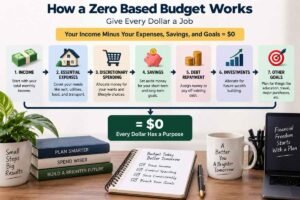
A zero based budget starts with your expected income and then assigns that income to different categories.
Let’s say your monthly income is $3,000.
Your first job is not to spend the money. Your first job is to create a plan.
You could allocate your income like this:
| Category | Planned Amount |
|---|---|
| Housing | $900 |
| Groceries | $350 |
| Transportation | $200 |
| Utilities | $200 |
| Debt Payments | $300 |
| Savings | $400 |
| Investments | $200 |
| Entertainment | $150 |
| Personal Spending | $150 |
| Other Expenses | $150 |
| Total | $3,000 |
Your income is $3,000 and your planned allocations total $3,000.
That gives you a zero based budget.
The exact numbers will be different for every person. Your housing costs, income, debt, family situation, financial goals, and location all affect how your money should be allocated.
This approach is also an important part of managing your money effectively, because it helps you make intentional decisions about spending, saving, and financial goals.
Why Use a Zero Based Budget?
A zero based budget can be useful because it forces you to become intentional about your money.
Instead of asking, “How much money do I have left to spend?” you ask, “What should this money accomplish?”
If you are working with a limited income, learning how to save money on a low income can help you find more room for savings in your monthly budget.
The Consumer Financial Protection Bureau also recommends creating a realistic budget to understand where your money goes and how much you can put toward savings goals.
Here are some potential benefits.
It Gives Every Dollar a Purpose
Unplanned money can easily disappear through small purchases.
When you assign your income to specific categories, you become more aware of where your money is going.
It Helps You Control Spending
A zero based budget gives you a spending plan before the month begins.
This can make it easier to recognize when you are spending more than you intended.
It Can Make Saving More Consistent
Savings become part of the budget rather than something you hope to do at the end of the month.
Instead of saving whatever happens to remain, you assign money to savings as part of your plan.
It Can Help With Debt Repayment
You can also give a specific portion of your income to debt payments.
This makes debt repayment a planned financial priority rather than an afterthought.
It Helps You Prepare for Irregular Expenses
Not every expense happens every month.
A zero based budget can include categories for expenses that occur occasionally, such as annual insurance payments, vehicle maintenance, gifts, school expenses, or travel.
How to Create a Zero Based Budget Step by Step
Creating a zero based budget is easier when you follow a simple process.
Step 1: Calculate Your Monthly Income
Start by figuring out how much money you expect to receive during the month.
Include reliable sources of income such as:
- Salary
- Freelance income
- Business income
- Part time income
- Other regular income
If your income changes every month, creating a budget requires a little more planning.
You may want to base your initial budget on a conservative estimate rather than assuming you will earn the highest amount possible.
For example, if your freelance income changes from month to month, you could build your essential budget around a lower realistic income level and assign additional income when it arrives.
The key is to work with money you reasonably expect to receive.
Step 2: List Your Essential Expenses
Next, write down your necessary monthly expenses.
These might include:
- Rent or mortgage
- Groceries
- Electricity
- Water
- Internet
- Transportation
- Insurance
- Healthcare
- Minimum debt payments
These expenses generally come before optional spending.
However, your exact priorities will depend on your personal circumstances.
Do not worry about making the budget perfect at this stage. The goal is to understand what your basic financial responsibilities look like.
Step 3: Add Your Financial Goals
Now include your financial goals.
This is where a zero based budget becomes especially useful.
Your goals might include:
- Building an emergency fund
- Paying off debt
- Saving for education
- Saving for a major purchase
- Investing
- Building retirement savings
- Saving for a future trip
Treat these goals as planned allocations rather than leftover money.
If debt repayment is one of your main priorities, learning how to pay off debt faster can help you decide how much of your monthly income to dedicate to debt payments.
If you are still building your financial safety net, learning how to build an emergency fund from scratch can help you decide how much to allocate toward this goal each month.
For example, if building an emergency fund is important to you, include an emergency-fund contribution in your monthly budget.
You can then track your progress over time.
Step 4: Add Flexible Spending
A good budget should leave room for normal life.
Add categories such as:
- Dining out
- Entertainment
- Clothing
- Hobbies
- Personal care
- Shopping
- Social activities
A budget that leaves no room for anything enjoyable can be difficult to maintain.
The goal is not to eliminate every optional expense. It is to decide how much you can reasonably spend while still making progress toward your financial goals.
Step 5: Include Irregular Expenses
This step is often missed by beginners.
Some expenses do not happen every month, but that does not make them unexpected.
For example, suppose you spend money on car maintenance several times a year.
Instead of waiting until the expense arrives, you can set aside a smaller amount each month.
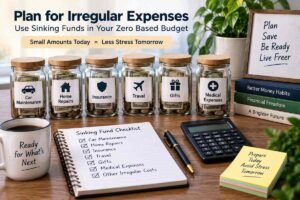
This is often called a sinking fund.
If you want to understand this strategy in more detail, our guide on how to create a sinking fund explains how to prepare for predictable future expenses without disrupting your monthly budget.
You can create separate categories for expenses such as:
- Vehicle maintenance
- Annual subscriptions
- Gifts
- Holidays
- School expenses
- Home repairs
- Insurance
- Medical expenses
Planning ahead can prevent these expenses from completely disrupting your monthly budget.
The CFPB recommends looking back over several months so you do not miss less frequent expenses such as insurance, medical costs, gifts, and vacations.
Step 6: Give Every Dollar a Job
Now start assigning your income.
Your goal is:
Income – All Planned Allocations = $0
If you have money left over, do not simply leave it unassigned.
Give it a purpose.
You could allocate the remaining amount toward:
- Savings
- Debt repayment
- Investments
- A sinking fund
- A future purchase
- A reasonable amount of personal spending
This is the central idea behind a zero based budget.
Every part of your income has a planned destination.
Step 7: Check Your Budget Total
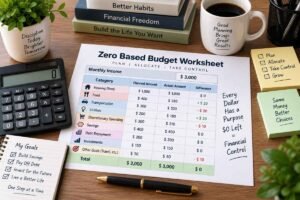
Add all your categories together.
If your income is $3,000 and your planned allocations total $2,700, you still have $300 to assign.
If your allocations total $3,200, you need to reduce some categories by $200.
Your goal is to reach:
Income = Planned Allocations
When both sides match, your budget is zero-based.
Step 8: Track Your Actual Spending
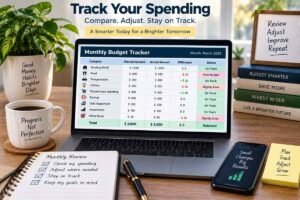
Creating the budget is only the beginning.
During the month, record what you actually spend.
For example:
| Category | Planned | Actual |
|---|---|---|
| Groceries | $350 | $375 |
| Transportation | $200 | $180 |
| Entertainment | $150 | $120 |
| Savings | $400 | $400 |
This comparison helps you understand how closely your actual behavior matches your plan.
You will probably make mistakes during your first few months.
That is normal.
A budget should become more accurate as you learn your real spending patterns.
Keeping a record of your expenses can give you a clearer picture of your spending habits and help you make better budgeting decisions, as explained in the CFPB’s guide to tracking your spending.
What If Your Income Changes During the Month?
Variable income can make zero based budgeting more challenging, but it is still possible.
Suppose you earn money from freelancing, commissions, or a small business.
Instead of assigning money you have not received yet, you can create your budget based on the income you reasonably expect.
When additional income arrives, assign it according to your priorities.
For example, additional income could go toward:
- Essential expenses
- Savings
- Debt repayment
- Investments
- Other financial goals
- Flexible spending
The exact order depends on your circumstances.
The important point is to avoid treating uncertain future income as guaranteed money.
When your income or expenses change, it is important to update your budget so your plan continues to reflect your current financial situation.
What If You Overspend in One Category?
Overspending does not mean your entire budget has failed.
It simply means you need to make an adjustment.
Suppose you planned to spend $150 on entertainment but ended up spending $200.
You are $50 over your plan.
You can review your other categories and decide whether you can reduce spending somewhere else.
For example, you might spend less on shopping or dining out.
This process is sometimes called reallocating your budget.
A zero based budget is not supposed to be a rigid document that never changes. It is a system that helps you make intentional decisions when circumstances change.
How to Handle Unexpected Expenses
Unexpected expenses are one of the biggest challenges for beginners.
You may suddenly need to pay for a medical expense, urgent repair, or other financial emergency.
This is one reason an emergency fund is important.
You can also include a small miscellaneous category in your budget for expenses that do not fit neatly into other categories.
When something unexpected happens, review your budget before immediately reaching for a credit card or borrowing money.
If you have available savings, an emergency fund, or flexible categories that can be adjusted, you may have more options.
Zero Based Budget vs. Traditional Budget
The biggest difference is how you treat your remaining money.
With a simple traditional budget, you might calculate your income, subtract expenses, and then see what remains.
With a zero based budget, you intentionally assign the remaining money to specific purposes.
For example:
Traditional approach:
Income → Expenses → Whatever remains
Zero-based approach:
Income → Planned expenses + savings + debt payments + investments + goals → $0 remaining unassigned
Neither method is automatically right for every person.
The advantage of the zero based approach is that it encourages more intentional planning.
How Often Should You Create a Zero Based Budget?
Most people can create or update their budget once a month.
At the beginning of the month:
- Estimate your income
- Review upcoming expenses
- Assign money to each category
- Include savings and financial goals
- Check that the budget reaches zero
During the month, track your spending.
At the end of the month, review what happened.
Ask yourself:
- Which categories did I underestimate?
- Where did I overspend?
- Did I reach my savings goal?
- Did any unexpected expenses occur?
- What should I change next month?
This monthly review helps your budget become more realistic over time.
Common Zero Based Budgeting Mistakes
Making the Budget Too Strict
If you completely eliminate entertainment and personal spending, you may find the budget difficult to follow.
Leave some room for normal life.
Forgetting Irregular Expenses
Annual and occasional expenses can destroy an otherwise good budget if you do not plan for them.
Create sinking funds for predictable irregular costs.
Using Unrealistic Numbers
Do not create a budget based on what you wish you spent.
Use your actual spending history as a starting point.
Treating Savings as Whatever Is Left
If savings are important, make them part of your plan.
Do not rely entirely on saving whatever remains at the end of the month.
Giving Up After One Bad Month
A budget is a learning system.
You will probably make mistakes.
Instead of abandoning the entire system, identify what went wrong and adjust the next month’s plan.
Simple Zero Based Budget Example for Beginners
Let’s put everything together.
Imagine a beginner earns $3,000 in a month.
Their planned budget might look like this:
| Category | Amount |
|---|---|
| Housing | $900 |
| Groceries | $350 |
| Transportation | $200 |
| Utilities | $200 |
| Debt Payments | $300 |
| Emergency Fund | $250 |
| Investments | $150 |
| Entertainment | $150 |
| Personal Spending | $150 |
| Irregular Expenses | $150 |
| Other Goals | $200 |
| Total | $3,000 |
The income is $3,000.
The planned allocations are also $3,000.
That means:
$3,000 – $3,000 = $0
Every dollar has a job.
Again, these numbers are only an example. Your own budget should be based on your actual income, expenses, goals, and financial responsibilities.
Tools You Can Use to Create a Zero Based Budget
You do not need expensive software to get started.
You can create a zero based budget using:
- A notebook
- Microsoft Excel
- Google Sheets
- A budgeting app
- A simple spreadsheet on your phone
The best tool is usually the one you will actually use consistently.
If you are a complete beginner, start with something simple.
Create columns for:
Category | Planned | Actual | Difference
Then update the spreadsheet throughout the month.
Once you understand your spending habits, you can decide whether you need a more advanced budgeting system.
Tips to Make Zero Based Budgeting Easier
Start With Your Previous Spending
Review the previous month before creating your first budget.
Your actual spending can help you set realistic categories.
Keep Categories Simple
You do not need 50 different categories.
Start with the major areas of your financial life and add more categories only when they are useful.
Budget Before You Spend
Create your plan at the beginning of the month instead of waiting until the money is already gone.
Review Your Budget Regularly
Your financial situation can change.
Update your budget when your income, expenses, or goals change.
Give Yourself Some Flexibility
The purpose of budgeting is to help you control your money, not make you feel guilty about every purchase.
Make adjustments when necessary.
Final Thoughts
Learning how to create a zero based budget for beginners can give you a clearer picture of where your money is going and what you want it to accomplish.
The basic idea is simple: take your expected income and assign it to expenses, savings, debt payments, investments, and financial goals until every dollar has a planned purpose.
The goal is not to spend every dollar. It is to make sure no money is left without a purpose.
Start by calculating your income, listing your essential expenses, adding savings and financial goals, planning for irregular expenses, and then allocating the remaining money to useful categories.
Track your actual spending throughout the month and review your results afterward.
Your first budget will probably not be perfect, and that is completely fine. As you learn more about your spending habits, you can adjust your categories and create a system that works better for your life.
A good budget is not about restricting yourself. It is about giving your money direction so you can spend intentionally, save consistently, reduce financial stress, and work toward the goals that matter to you.