

A $1,000 expense does not have to become a $1,000 financial emergency.
If you know a large expense is coming, you can prepare for it little by little instead of scrambling to find the money when the bill arrives. That is the basic idea behind a sinking fund.
Maybe your car insurance is due in six months. Perhaps you have a family vacation coming up, annual school expenses, holiday gifts to buy, or a home repair you’ve been putting off. These expenses may not happen every month, but they can still put serious pressure on your budget when they arrive.
A sinking fund gives those expenses a place in your financial plan. An emergency fund is for something you don’t expect.
In this guide, you’ll learn how to create a sinking fund, how much to save, which expenses make good sinking fund goals, where to keep the money, and how to make the system work even if you are starting with a limited income.
What Is a Sinking Fund?
A sinking fund is money you set aside regularly for a specific expense you expect to pay in the future.
The important part is that the expense is usually predictable. You may know roughly how much it will cost and when you’ll need the money.
For example, imagine your car insurance costs $600 and the payment is due six months from now. Instead of trying to find $600 in the month the bill arrives, you could save $100 each month.
After six months:
$100 × 6 = $600
The expense hasn’t become cheaper. You’ve simply spread the cost across several months, making it easier for your regular budget to handle.
That is what makes sinking funds so useful.
“If you’re still figuring out how to divide your income between needs, wants, and savings, the 50/30/20 budgeting method can give you a simple starting point.”
Sinking Fund vs. Emergency Fund

Sinking funds and emergency funds are both savings tools, but they serve different purposes.
A sinking fund is for something you expect.
An emergency fund is for something you don’t expect.
For example, if you know your car insurance is due every year, you could prepare for it with a sinking fund. If your car suddenly breaks down and you face an unexpected repair, your emergency fund may be more appropriate.
Experian similarly describes a sinking fund as money set aside for a planned expense, while an emergency fund is designed for unexpected expenses.
Here is a simple way to think about it:
| Expense | Sinking Fund | Emergency Fund |
|---|---|---|
| Annual car insurance | Yes | No |
| Planned vacation | Yes | No |
| Holiday gifts | Yes | No |
| School expenses you expect | Yes | No |
| Unexpected car repair | No | Yes |
| Sudden loss of income | No | Yes |
| Unexpected home repair | No | Yes |
Money Helper explains that known upcoming costs are suitable for sinking funds, while unexpected financial problems are what emergency savings are designed to handle.
Keeping these two types of savings separate can also make your money easier to manage. You won’t have to wonder whether the money sitting in your emergency fund is actually available for a vacation or an annual bill.
Why Create a Sinking Fund?
The biggest benefit is simple: large, irregular expenses become easier to handle.
Imagine you need $1,200 for an annual expense. Seeing a $1,200 bill arrive in one month can be stressful, especially if your income is already committed to rent, food, transportation, debt payments, and other necessities.
But if you have twelve months to prepare, the same goal becomes:
$1,200 ÷ 12 = $100 per month
That is a much easier number to work into a monthly budget.
Sinking funds can also help you avoid putting predictable expenses on a credit card simply because you weren’t prepared for them. Current guidance from both Money Helper and NerdWallet highlights this benefit of preparing for known costs in advance.
“If you’re also working on debt, having money ready for predictable expenses can help you avoid adding those expenses to your credit cards while you pay off debt faster.
What Expenses Should You Use a Sinking Fund For?
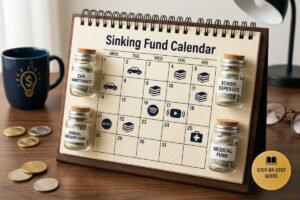
You don’t need a sinking fund for every expense you have.
In fact, creating too many categories can make your finances harder to manage.
Sinking funds are most useful for expenses that are:
- Predictable
- Relatively expensive
- Infrequent
- Easy to plan for in advance
Some common examples include:
- Car insurance
- Car maintenance
- Home repairs
- Annual subscriptions
- Holiday gifts
- Birthdays and celebrations
- Vacations
- School expenses
- Medical or dental costs you expect
- Professional fees
- Wedding expenses
- New electronics
- Clothing purchases
- Annual memberships
For example, you probably don’t need a sinking fund for your monthly groceries. That’s a regular budget expense.
But if you know you’ll need $500 for school expenses at the beginning of the next school year, that could be a good candidate.
The goal is to use sinking funds for expenses that could otherwise disrupt your normal monthly budget.
How to Create a Sinking Fund Step by Step

You don’t need a complicated spreadsheet or ten different bank accounts. You can start with a simple system.
1. List Your Upcoming Irregular Expenses
Start by looking ahead over the next 12 months.
Think about expenses that don’t appear every month but are likely to come up.
Look through your previous bank statements, bills, receipts, or calendar if you’re unsure. Last year’s spending can be a useful starting point for estimating future costs. MoneyHelper also recommends reviewing upcoming costs and previous expenses when setting up sinking funds.
Write down the expense, estimated cost, and expected date.
For example:
| Expense | Estimated Cost | When Needed |
|---|---|---|
| Car insurance | $600 | 6 months |
| Holiday gifts | $500 | 10 months |
| Vacation | $1,200 | 12 months |
You now have something concrete to work with.
2. Choose Your Highest Priorities
Don’t try to save for everything at once.
Start with expenses that would cause the biggest problem if you had to pay for them from one month’s income.
For example, if your car is essential for getting to work, car related expenses may deserve a higher priority than a vacation.
You can also separate needs from wants.
An annual insurance payment is different from a new television you’ve simply decided to buy. Both can potentially have sinking funds, but your essential expenses should generally come first when money is limited.
3. Decide How Much You Need
Next, estimate the total amount you’ll need for each goal.
Try to use a realistic number instead of choosing an amount that simply feels convenient.
If your car insurance was $550 last year, for example, saving exactly $550 may leave you short if the price increases. You might choose a slightly higher target to give yourself some breathing room.
The more accurate your target, the easier it becomes to calculate your monthly contribution.
4. Calculate How Much to Save
This is the part that makes sinking funds so practical.
Use this simple formula:
Amount needed ÷ number of months remaining = monthly contribution
Suppose you need $600 in six months.
$600 ÷ 6 = $100 per month
If you are paid twice a month, you could save $50 from each paycheck.
Now suppose you want to save $1,000 for a vacation over ten months.
$1,000 ÷ 10 = $100 per month
You don’t have to come up with $1,000 in one month. You’re simply turning a large future expense into a smaller monthly savings target.
If your income changes from month to month, you can also think in terms of each paycheck rather than a fixed monthly amount.
5. Choose Where to Keep the Money
A sinking fund should be easy to access when you need it, but separate enough from your everyday spending that you’re not tempted to use it for something else.
For many people, a separate savings account works well.
Some banks also offer savings buckets, pots, or similar features that allow you to separate money for different goals without opening a completely different account for each one. Money Helper specifically notes that savings accounts and accounts with savings pots can be practical options for sinking funds.
The right choice depends on where you live and what accounts are available to you.
The main things to consider are:
- Is the money safe?
- Can you access it when the expense arrives?
- Is it easy to track?
- Are there unnecessary fees or restrictions?
For money you’ll need relatively soon, don’t put the sinking fund into something whose value could fall significantly right when you need to make the payment.
6. Automate Your Savings
This is one of the simplest ways to make the system easier.
If you have to remember every month to move money into your sinking fund, eventually you may forget.
Instead, set up an automatic transfer if your bank allows it.
For example:
Payday → $100 automatically moves to your car fund.
You don’t have to make the decision again next month.
Automatic savings can turn the sinking fund into part of your normal financial routine. Money Helper also recommends setting up recurring transfers for savings goals.
7. Use the Money for Its Intended Purpose
When the expense arrives, use the money you saved for that expense.
Suppose you’ve saved $600 for your annual car insurance.
The bill arrives.
You pay it from the car sinking fund.
You don’t need to pull money from your emergency savings or suddenly find room for a $600 expense in your normal monthly budget.
If the expense happens every year, you can start rebuilding the fund immediately after making the payment.
What If You’re Starting With $0?
This is where many beginners get discouraged.
They look at their upcoming expenses and realize they need thousands of dollars. Then they assume sinking funds aren’t possible for them.
That’s not true.
You don’t have to build every fund at once.
If you only have $50 available this month, start with $50.
If one expense is more urgent than the others, give it priority.
For example, suppose you have:
- $40 available for car expenses
- $30 for holiday gifts
- $20 for a future vacation
You don’t necessarily have to divide the money equally. If your car insurance is due in two months, while the vacation is next year, the car fund may deserve more attention right now.
A small amount saved consistently is more useful than a perfect savings plan you never follow.
“If you’re working with a tight budget, you may also find these money saving strategies for a low income useful when looking for extra room in your monthly budget.”
How Many Sinking Funds Should You Have?
There is no magic number.
Some people are comfortable managing several separate funds. Others prefer one general savings account with a simple spreadsheet showing what each portion is for.
The important thing is that your system remains easy enough to maintain.
If you’re constantly asking yourself where your money is supposed to go, you’ve probably created too many categories.
Start with two or three important goals.
Once the system becomes a habit, you can add more if you actually need them.
NerdWallet also notes that too many sinking funds can become difficult to manage and recommends starting with your priorities rather than creating an overwhelming number of categories.
NerdWallet also notes that too many sinking funds can become difficult to manage, so it’s usually better to start with your most important goals and add categories only when you actually need them.
“The goal is to build a system that fits into the way you already manage your money rather than creating a complicated system you won’t maintain.”
A Simple Sinking Fund Example
Let’s put everything together.
Imagine you want to prepare for three expenses over the next year:
Car insurance: $600 in 6 months
Holiday gifts: $500 in 10 months
Vacation: $1,200 in 12 months
Your monthly targets would be:
Car insurance: $600 ÷ 6 = $100
Holiday gifts: $500 ÷ 10 = $50
Vacation: $1,200 ÷ 12 = $100
You would need to save:
$100 + $50 + $100 = $250 per month
If $250 isn’t realistic for your current budget, don’t simply give up.
Look at the goals again.
Maybe you can reduce the vacation target, extend the timeline, lower your gift budget, or prioritize the most important expense first.
A sinking fund should fit into your financial reality. It shouldn’t force you to ignore essential bills or take on new debt.
Common Sinking Fund Mistakes

Creating Too Many Funds
More categories don’t automatically mean better organization. Start with your most important expenses.
Guessing Your Target
Use previous bills or realistic estimates when possible. An inaccurate target can leave you short.
Waiting Until the Last Minute
The earlier you start, the smaller your regular contributions can be.
Spending the Money on Something Else
If you’ve saved $500 for a specific expense, don’t treat that money as spare cash.
Using Your Emergency Fund for Planned Expenses
If you knew the expense was coming, it probably belongs in your regular financial plan rather than being treated as an emergency.
Making the System Too Complicated
The best system is one you’ll actually use.
What Should You Do With Leftover Money?
Sometimes you’ll save more than you eventually need.
Suppose you saved $600 for an expense but only spent $550.
You have $50 left.
You could leave it in the fund to give yourself a head start next year, move it toward another savings goal, or add it to your emergency savings.
There isn’t one correct answer.
If the expense happens every year, keeping the extra money in that fund can make next year’s goal easier.
Final Thoughts
Learning how to create a sinking fund is really about changing the way you think about large expenses.
Instead of treating every big bill as a surprise, you start planning for the expenses you already know are coming.
You don’t need a high income, a complicated spreadsheet, or ten different savings accounts to get started.
Choose one upcoming expense.
Estimate how much you’ll need.
Work out how many months you have.
Divide the amount by the number of months.
Then automate the savings if you can.
For example, a $600 expense six months from now becomes a $100 monthly goal. That’s much easier to plan for than trying to find the entire $600 at the last minute.
Start with one sinking fund, make the system simple, and build from there.
The goal isn’t to save perfectly. The goal is to stop predictable expenses from turning into financial emergencies.