

Have you ever checked your credit report and found information that does not look right? Maybe a payment is marked late even though you paid on time, a balance is incorrect, or an account appears that you do not recognize.
Credit report errors can happen, and they should not be ignored. Incorrect information can make your financial history look different from reality and may create problems when you apply for credit or other financial services.
The good news is that you can usually ask the relevant credit reporting agency and the company that provided the information to investigate genuine errors. The exact process, agencies, deadlines, and consumer rights vary by country, but the basic approach is similar.
In this guide, you will learn how to dispute errors on your credit report, what mistakes to look for, how to collect evidence, how to submit a dispute, and what to do if the information is not corrected.
Important: Credit reporting rules differ around the world. This guide provides general educational information, not country specific legal advice. Always check the official credit reporting agency or financial regulator in your country for the rules that apply to you.
What Is a Credit Report?

A credit report is a record of information about your borrowing and repayment history. Depending on where you live, it may contain details about credit cards, loans, mortgages, payment history, balances, credit limits, account dates, defaults, collections, and personal identification information.
Lenders and financial institutions may use information from your credit report when assessing applications for credit. Your credit report is different from your credit score. A credit score is usually a number calculated from information in your credit history, while the report contains the underlying details.
That is why checking the report itself is important.
What Is a Credit Report Error?
A credit report error is information on your credit file that is inaccurate, incomplete, duplicated, outdated under applicable rules, or associated with the wrong person.
Common examples include:
- An account you never opened
- A payment incorrectly marked late
- An incorrect balance
- An incorrect credit limit
- The same debt appearing more than once
- A closed account shown as open
- Incorrect personal information
- An incorrect account status
Not every unfamiliar entry is necessarily an error. You may have forgotten an old account, or you may have been added as an authorized user. Investigate the information before submitting a dispute.
Why Should You Dispute Credit Report Errors?
Your credit history can affect important financial decisions. Depending on your country, lenders may consider credit information when you apply for a loan, credit card, mortgage, or other financial service.
Imagine that you paid a loan installment on time, but the lender accidentally reported it as late. Someone reviewing your credit history could see a negative payment record that does not represent what actually happened.
Correcting genuine errors helps your credit report more accurately reflect your financial history.
Common Credit Report Errors to Look For
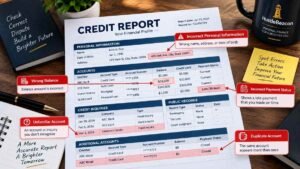
Before disputing anything, carefully review your entire credit report.
Incorrect Personal Information
Check your name, date of birth, address, contact information, and other identifying details. An error may be harmless, but incorrect personal information can sometimes indicate that information from different people has been mixed together.
Accounts You Never Opened
An unfamiliar account could be a reporting mistake, an account you forgot about, or an account opened fraudulently. Check your own records and contact the company associated with the account if you do not recognize it.
Incorrect Late Payments
Review your payment history carefully. Look for payments incorrectly listed as late, missed, or in default. If your records show that you paid on time, keep evidence such as bank statements or payment confirmations.
Incorrect Balances
Compare the balances on your credit report with recent account statements. If the amount reported does not match your records, identify the difference and collect documents that show the correct information.
Incorrect Credit Limits
If your report includes credit limits, make sure they are accurate. An incorrect limit can affect the way your credit utilization appears.
Duplicate Debts
Look for the same debt being reported more than once. Compare account names, dates, balances, and other details to determine whether two entries actually represent the same obligation.
Incorrect Account Status
Check whether accounts are correctly shown as open, closed, current, delinquent, or otherwise reported. If you closed an account but it is still shown as active, for example, investigate the discrepancy.
How to Dispute Errors on Your Credit Report
Once you identify a genuine error, follow these steps.
Step 1: Get Your Credit Report
Start by obtaining your latest credit report from the official credit reporting agency or agencies operating in your country.
Some countries have one major agency, while others have several. If more than one agency operates where you live, consider checking multiple reports because they may not contain identical information.
Save a copy of the report so you can compare it with an updated version later.
Step 2: Review the Report Carefully
Do not focus only on your credit score. Read the information behind the score.
Check your personal details, accounts, balances, credit limits, payment history, account status, dates, defaults, collections, and unfamiliar accounts.
Make a list of anything you believe is incorrect.
Step 3: Identify Exactly What Is Wrong
Be specific about the information you are challenging.
Instead of writing, “My credit report is wrong,” explain the exact problem.
For example:
“The report shows a late payment for this account, but my records show that the payment was made before the due date.”
Or:
“This account does not belong to me.”
Or:
“The reported balance does not match my latest statement.”
A clear explanation makes it easier for the organization reviewing your dispute to understand what needs to be investigated.
Step 4: Gather Supporting Evidence
Documents can help support your claim. Depending on the error, you may use:
- Bank statements
- Loan or credit card statements
- Payment receipts
- Transaction records
- Emails
- Account closure confirmations
- Letters from financial institutions
- Relevant screenshots
- Fraud or identity theft documentation
Keep your original documents safely stored and submit copies when possible.
Step 5: Contact the Credit Reporting Agency
Contact the agency that is reporting the incorrect information. Use its official dispute process, which may be available online, by mail, email, or another approved method.
Follow the agency’s instructions carefully. You will usually need to provide enough information to identify yourself, identify the disputed account or entry, explain the error, and provide supporting evidence.
Avoid sending sensitive information through unofficial websites or unknown contacts.
Step 6: Contact the Company That Reported the Information
The company that provided the information is often a bank, lender, credit card company, collection agency, or another financial business.
If that company supplied incorrect information, contact it directly as well.
For example, if a lender reported a payment as late when you paid on time, you can challenge the information with the credit reporting agency and ask the lender to investigate its own records.
This is important because the original company may need to correct the information it supplied.
Step 7: Keep Records of Your Dispute

Save everything related to your dispute.
Keep copies of your request, supporting documents, emails, letters, confirmation numbers, delivery receipts, responses, and updated credit reports.
If you submit a dispute online, save the confirmation or reference number. If you send it by mail, keep proof of delivery when available.
Good records make it easier to follow up if the problem continues.
How Long Does a Credit Report Dispute Take?
There is no single worldwide timeframe for credit report disputes.
The time can depend on your country, the credit reporting agency, the company involved, the type of error, and how much investigation is required.
Some disputes may be resolved quickly, while others take longer.
When you submit your dispute, check the official information provided by the relevant agency to understand its expected timeframe. If the stated period passes without a response, follow up using your reference number.
What Happens After You Submit a Dispute?
The organization handling your dispute will generally review the information and investigate the disputed entry. It may contact the company that supplied the information to verify the details.
There are several possible outcomes.
The Information Is Corrected
If the information is found to be inaccurate, the record may be corrected or updated.
The Information Is Confirmed
The organization may determine that the information is accurate and leave it unchanged.
More Information Is Requested
You may be asked to provide additional documents or clarification.
Read the final response carefully and check your updated report instead of assuming the issue has been resolved.
What If the Error Is Not Corrected?
If your dispute is rejected or the information remains unchanged, read the explanation carefully.
Then review your evidence and ask:
- Did I identify the exact error?
- Did I provide enough supporting documents?
- Did I contact the company that supplied the information?
- Did I use the official dispute process?
- Can I provide additional evidence?
If you have new evidence, you may be able to request another review or provide additional information, depending on the rules in your country.
You can also research whether your country has a financial regulator, consumer protection authority, ombudsman, or other official dispute-resolution service.
What If You Find an Account You Never Opened?

Take an unfamiliar account seriously.
First, check your own records and contact the company associated with the account. If you are certain you never opened it, contact the credit reporting agency as well.
The account could be the result of an administrative mistake, mixed personal information, or identify theft.
If you suspect identity theft, consider changing important passwords, monitoring your financial accounts, contacting the affected institution, and reporting the suspected fraud to the appropriate authority in your country.
Can You Remove Accurate Negative Information?
A credit report dispute is generally meant to correct inaccurate or incomplete information. It is not simply a method for removing information because it negatively affects your credit score.
For example, if you genuinely missed a payment and the company correctly reported it, you should not claim that the payment was an error simply because it hurts your credit history.
Be cautious of anyone who promises to erase legitimate negative information or guarantees a particular credit score. Never provide false information as part of a dispute.
Do You Need a Credit Repair Company?
Not necessarily.
In many places, consumers can challenge inaccurate information themselves by contacting the relevant credit reporting agency and the company that supplied the information.
A credit repair company may offer to handle the process for you, but understand what you are paying for before signing a contract.
Be especially careful if a company:
- Guarantees a specific credit score
- Promises to remove accurate negative information
- Tells you to dispute information you know is correct
- Encourages you to provide false information
- Requests large payments without clearly explaining its services
For a straightforward error, you may be able to begin the process yourself.
How Often Should You Check Your Credit Report?
Checking your credit report periodically can help you find problems earlier.
You may also want to review it before applying for an important financial product such as a loan, mortgage, credit card, or vehicle financing.
If you discover an error shortly before applying, you may not have enough time to resolve it. Regular checks give you more time to investigate problems and keep your financial records accurate.
Final Thoughts
Learning how to dispute errors on your credit report is an important part of managing your finances.
If you discover inaccurate information, do not simply ignore it. Review the entry carefully, identify exactly what is wrong, and gather evidence that supports your claim.
Then contact the relevant credit reporting agency and the company that supplied the information. Keep records throughout the process and review the final result carefully.
Remember that credit reporting systems differ around the world. The agencies, dispute procedures, investigation periods, and consumer protections available to you depend on your country.
Most importantly, dispute information because it is genuinely inaccurate or incomplete, not simply because it has a negative effect on your credit.
Regular credit-report checks can help you catch mistakes early.
Frequently Asked Questions
What types of credit report errors can I dispute?
You can generally challenge information that is inaccurate, incomplete, duplicated, or associated with the wrong person. Rules concerning outdated information vary by country.
How long does a credit report dispute take?
There is no universal worldwide timeframe. The time required depends on the country, reporting agency, company involved, and complexity of the dispute.
What should I do if I find an account I never opened?
Investigate it promptly. Contact the company associated with the account and the relevant credit reporting agency. If you suspect identity theft, follow your country’s official fraud-reporting and recovery process.
Can I remove a genuine late payment?
A genuine late payment generally cannot be removed simply because it damages your credit. If it was reported incorrectly, you can dispute it and provide evidence supporting your claim.
Will disputing an error increase my credit score?
Not necessarily. The purpose of a dispute is to correct inaccurate information. If an error is corrected, your score may change depending on how the incorrect information affected your credit profile, but an increase is not guaranteed.
What should I do after an error is corrected?
Review your updated credit report to make sure the incorrect information has actually been corrected. Keep your dispute records and supporting documents for future reference.