

Investing is not something you can simply set up once and forget about forever. As your investments grow, their values change at different rates. One investment may perform very well while another grows slowly or even loses value. Over time, this can change the balance of your portfolio and leave you taking more or less risk than you originally intended.
This is where portfolio rebalancing comes in.
Rebalancing an investment portfolio means adjusting your investments back toward your desired mix of assets. For example, you may have originally decided to keep 60% of your portfolio in stocks and 40% in bonds. If stocks perform strongly, your portfolio might eventually become 70% stocks and 30% bonds. Rebalancing would bring those percentages closer to your original plan.
For beginners, the idea may sound complicated, but it does not have to be.
In this guide, you will learn how to rebalance an investment portfolio, when to do it, how often you should consider rebalancing, and common mistakes to avoid.
What Is Portfolio Rebalancing?

Portfolio rebalancing is the process of adjusting your investments so your portfolio returns closer to your chosen asset allocation.
Your asset allocation is simply how your money is divided among different types of investments.
If you are completely new to investing, you can first learn how to start investing as a beginner before building and managing your portfolio.
For example, a beginner investor might have a portfolio that looks like this:
- 60% stocks
- 30% bonds
- 10% cash
This allocation represents the investor’s preferred balance between growth and stability.
However, investments do not all move in the same direction or at the same speed. If stocks increase significantly while bonds remain relatively stable, stocks could become a larger percentage of the portfolio.
The portfolio might eventually look like this:
- 70% stocks
- 25% bonds
- 5% cash
The investor is now taking more stock market exposure than originally planned.
Rebalancing means making adjustments to bring the portfolio closer to the original target.
Why Is Rebalancing an Investment Portfolio Important?
The main reason to rebalance is to keep your portfolio aligned with your investment plan.
When you first build a portfolio, your asset allocation should generally reflect factors such as your goals, time horizon, and tolerance for investment risk.
Without occasional adjustments, market performance can gradually change that allocation.
The right asset allocation depends on factors such as your investment time horizon and risk tolerance. The U.S. Securities and Exchange Commission’s Investor.gov explains how these factors can affect an investor’s asset allocation and diversification strategy.
1. It Keeps Your Risk Level on Track
Different investments carry different levels of risk.
Stocks generally have greater potential for long-term growth but can experience larger price fluctuations. Bonds and cash may behave differently and can provide more stability depending on the type and market environment.
If stocks become a much larger part of your portfolio than planned, your overall portfolio may become more exposed to stock market movements.
Rebalancing can help bring your portfolio back toward the risk level you originally intended.
2. It Helps You Follow a Plan
Investing can become emotional when markets rise or fall.
When an investment performs extremely well, it can be tempting to keep buying more of it because you believe the gains will continue. When markets fall, you may feel like selling everything.
A predetermined rebalancing strategy gives you a process to follow instead of making every decision based on short-term market movements.
3. It Prevents One Investment From Taking Over
Imagine that you own several investments, but one of them grows much faster than the others.
Without rebalancing, that investment can eventually represent a very large percentage of your portfolio.
This creates concentration risk.
Rebalancing can help prevent your portfolio from becoming overly dependent on one asset, sector, or investment.
How to Rebalance an Investment Portfolio Step by Step
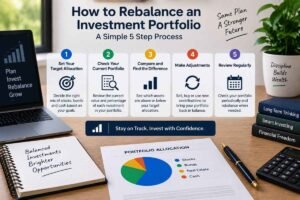
If you are a beginner, you do not need a complicated system.
If you want to understand these concepts in more detail, Investor.gov provides a beginner’s guide to asset allocation, diversification, and rebalancing.
Here is a simple process you can follow.
Step 1: Decide on Your Target Asset Allocation
Before rebalancing, you need to know what your target allocation is.
For example, suppose your investment plan is:
- 70% stocks
- 20% bonds
- 10% cash
These percentages are your target allocation.
Your own allocation may be completely different. There is no universal allocation that is appropriate for every investor.
Your investment goals, time horizon, financial situation, and ability to tolerate losses all matter when deciding on an allocation.
The important thing is to establish a plan before trying to rebalance.
Step 2: Check Your Current Portfolio
Next, look at what you currently own and calculate the percentage represented by each asset category.
Suppose your portfolio is currently worth $10,000.
You originally wanted:
- $7,000 in stocks
- $2,000 in bonds
- $1,000 in cash
But after market movements, your portfolio now looks like:
- $7,800 in stocks
- $1,700 in bonds
- $500 in cash
Your percentages have changed.
Stocks now represent 78% of the portfolio, while cash represents only 5%.
This tells you that your current allocation is different from your target allocation.
Step 3: Compare Your Current Allocation With Your Target
Now compare the two numbers.
For example:
| Asset | Target | Current |
|---|---|---|
| Stocks | 70% | 78% |
| Bonds | 20% | 17% |
| Cash | 10% | 5% |
Stocks are above their target while bonds and cash are below their targets.
This does not automatically mean you need to make a trade immediately. Instead, it tells you that your portfolio has drifted away from your original plan.
Step 4: Choose a Rebalancing Method
There are several ways to rebalance.
Sell Some of the Overweight Investments
One option is to sell part of the investments that have grown beyond your target allocation and use the proceeds to purchase assets that are below their target.
For example, if stocks have become too large a portion of your portfolio, you could sell some stock investments and direct the money toward other asset classes.
However, selling investments can have tax consequences in some countries and account types.
You should understand the potential tax impact before selling.
Buy More of the Underweight Investments
Another approach is to direct new contributions toward investments that are below their target.
For example, instead of selling stocks, you could use your next investment contribution to purchase more bonds or another underweight asset.
This can help move your portfolio closer to its target without necessarily selling existing investments.
For beginners, this approach can sometimes be simpler because you are using new money rather than immediately selling investments.
Use a Combination of Both
You can also combine the two approaches.
You might direct new contributions toward underweight investments and sell certain holdings only when the difference becomes significant.
The best approach depends on your portfolio, account type, taxes, transaction costs, and investment strategy.
Step 5: Check Your Portfolio Again
After making your adjustments, calculate your allocation again.
The goal is not necessarily to hit your target percentages down to the last decimal point.
For example, if your target is 70% stocks and you end up at 69.5%, there may be little reason to make another transaction just to reach exactly 70%.
The goal is to keep your portfolio reasonably close to your intended allocation.
How Often Should You Rebalance Your Portfolio?
There is no single schedule that every investor needs to follow.
Some investors review their portfolio every few months. Others check once or twice a year.
A common approach is to review your portfolio periodically and rebalance when your allocation has moved meaningfully away from your target.
For example, you might decide to review your portfolio once or twice each year.
Another approach is to use a percentage threshold.
Suppose your target for stocks is 60%. You might decide to rebalance if stocks move sufficiently above or below that target according to a rule you established in advance.
Individual investments can also behave differently from broader funds. If dividend paying companies are part of your strategy, our guide on how to invest in dividend stocks for beginners explains the basics.
The important part is having a consistent process.
Rebalancing too frequently can create unnecessary trading, costs, taxes, and complexity.
On the other hand, ignoring your portfolio for many years can allow the allocation to drift substantially.
There are several ways to approach portfolio rebalancing, including using a regular schedule or setting a threshold. Vanguard explains different approaches to rebalancing your portfolio that investors can consider.
What Is a Rebalancing Threshold?
A rebalancing threshold is a predetermined amount of portfolio drift that triggers a review or adjustment.
For example, suppose your target allocation for stocks is 60%.
If your chosen threshold is 5 percentage points, you might review the portfolio when the stock allocation reaches 65% or falls to 55%.
The exact threshold you choose depends on your investment strategy.
A threshold-based approach can be useful because it removes some emotion from the decision.
Instead of thinking, “The market has gone up, so I should probably sell,” you are following a rule you established beforehand.
Should Beginners Rebalance Every Month?
Usually, there is no need to rebalance simply because a month has passed.
Markets move constantly, so your portfolio may shift slightly every day.
Trying to correct every small movement can turn investing into an unnecessary cycle of buying and selling.
A better approach for many long term investors is to use a longer review period or a meaningful threshold.
The objective is not to keep your portfolio perfectly balanced every day.
The objective is to keep it reasonably aligned with your long-term investment plan.
Can You Rebalance Without Selling Investments?

Yes.
One of the simplest ways is to use new contributions.
Imagine your target is:
- 70% stocks
- 30% bonds
But your portfolio has gradually moved to 75% stocks and 25% bonds.
Instead of immediately selling stocks, you could direct some of your future contributions toward bonds.
Over time, this may bring the portfolio closer to its target allocation.
This approach can be particularly useful when selling would create taxes or transaction costs.
ETFs can also be useful for investors who want to build a diversified portfolio with a relatively simple investment structure. If you are learning about this approach, check out our guide on how to invest in ETFs for beginners.
However, whether it works efficiently depends on how large the portfolio is and how far it has drifted from the target.
What About Rebalancing Inside a Retirement Account?
The process can be different depending on the type of account and the tax rules that apply.
Some retirement accounts may allow investors to buy and sell investments without creating the same immediate tax consequences that can occur in a taxable investment account.
However, rules vary significantly by country and account type.
If you are investing through a retirement or tax-advantaged account, check the specific rules that apply to your account before making changes.
Common Portfolio Rebalancing Mistakes Beginners Should Avoid
Rebalancing is simple in principle, but there are several mistakes beginners can make.
Rebalancing Too Frequently
You do not need to adjust your portfolio every time the market moves.
Frequent trading can increase costs and may create unnecessary tax consequences.
Create a clear rebalancing rule and stick with it.
Chasing Recent Winners
Suppose one investment has performed extremely well.
You might feel tempted to increase your position because it has recently produced strong returns.
But buying more simply because something recently performed well can move your portfolio further away from your intended allocation.
Rebalancing is about following your investment plan rather than chasing recent performance.
Selling Everything During a Market Decline
A market decline can be uncomfortable, especially for a new investor.
However, rebalancing should not become an excuse to make emotional decisions.
If your long term plan remains appropriate, changing your entire strategy because of short-term market movements can create additional problems.
Ignoring Taxes and Fees
Before selling an investment, consider whether the transaction could create taxes, commissions, spreads, or other costs.
The costs depend on your country, investment account, broker, and type of investment.
These factors should be part of your rebalancing decision.
Making Your Portfolio Too Complicated
You do not need dozens of investments to have a diversified portfolio.
Adding more investments can sometimes make it harder to understand what you actually own and how everything fits together.
A simple portfolio that you understand can be easier to maintain.
A Simple Rebalancing Example for Beginners
Let’s look at a straightforward example.
Imagine you have a portfolio worth $20,000 and your target allocation is:
- 60% stocks
- 30% bonds
- 10% cash
Your target amounts would be:
- $12,000 in stocks
- $6,000 in bonds
- $2,000 in cash
After a period of market movement, your portfolio becomes:
- $14,000 in stocks
- $5,000 in bonds
- $1,000 in cash
Your portfolio is now more heavily weighted toward stocks than your original plan.
Instead of reacting emotionally, you review your rebalancing rule.
Depending on your strategy, you could direct new contributions toward bonds and cash, sell part of your stock holdings, or use a combination of both.
The key point is that the decision comes from your predetermined investment plan rather than from guessing what the market will do next.
Does Rebalancing Increase Investment Returns?
Rebalancing should not be viewed as a strategy that guarantees higher returns.
Its primary purpose is to maintain your desired asset allocation and risk exposure.
An investment that has performed well may continue performing well, or it may not. Similarly, an investment that has performed poorly may recover, or it may decline further.
Rebalancing does not allow you to predict these outcomes.
Instead, it provides a systematic way to maintain your chosen portfolio structure.
That distinction is important for beginners.
The goal of rebalancing is generally portfolio management, not trying to predict which investment will perform best next.
When Should You Rebalance Your Portfolio?
You may consider reviewing your portfolio when:
- Your investments have moved significantly away from their target allocation
- You reach a scheduled annual or semiannual review
- Your financial goals change
- Your investment time horizon changes
- Your risk tolerance changes
- You add substantial new money to the portfolio
- Your overall financial situation changes
A major life or financial change may also be a reason to revisit your overall asset allocation, not simply rebalance back to the old percentages.
This can be especially important when investing for long term goals such as retirement. If retirement investing is one of your goals, learn how to invest for retirement as a beginner.
For example, your original allocation may have made sense several years ago but may no longer fit your current goals.
How to Make Portfolio Rebalancing Easier

The easiest way to stay consistent is to create a simple system.
Write down your target allocation and your rebalancing rules.
For example:
My Investment Plan
Target allocation:
- Stocks: 60%
- Bonds: 30%
- Cash: 10%
Review schedule:
- Review portfolio twice per year
Rebalancing rule:
- Consider adjustments when an asset category moves significantly away from its target
Then record your portfolio whenever you review it.
You can use a simple spreadsheet to track:
- Investment name
- Asset category
- Current value
- Portfolio percentage
- Target percentage
- Difference from target
This turns rebalancing into a routine rather than an emotional decision.
Final Thoughts
Learning how to rebalance an investment portfolio is an important step for beginner investors.
Your portfolio will naturally change as different investments rise and fall. Without a plan, those changes can gradually move your portfolio away from the asset allocation you originally selected.
Rebalancing gives you a structured way to bring your investments back toward your target allocation.
You can rebalance by selling overweight investments, buying underweight investments, directing new contributions toward areas that need more money, or combining these approaches.
The most important thing is not to obsess over every small market movement. Instead, create a simple strategy, review your portfolio periodically, consider taxes and costs, and make adjustments based on your long-term investment plan.
Remember that rebalancing does not guarantee profits or prevent losses. It is simply a portfolio management technique designed to help keep your investment mix aligned with your goals and risk preferences.
If you are just starting to invest, focus first on building a diversified portfolio and understanding what you own. Once you have a clear investment plan, rebalancing becomes much easier to understand and manage.